Chemistry
MJRU-CHEMM

Chemistry

Undergraduate major

Experience science at a molecular level, where major advances are made in medicine, clean energy, forensic science and materials.

Course outline
  • Qualification
    Chemistry Major (BSc Science)
  • Credit

    Credit

    200
Course outline

You can study this course as part of the following degrees

Visit your preferred degree page for information on admission criteria, course fees and study locations.

Course outline

Overview

Overview

Chemistry is referred to as the ‘central science’, because it connects other sciences such as physics, biology and geology. It is science at a molecular level, where major advances are occurring in many areas – including in medicine, nanotechnology, sensors and environmental chemistry.

In this course, you will gain the knowledge to become a skilled chemist. You’ll study theoretical and practical aspects of chemistry, including synthesis, analysis and spectroscopy.

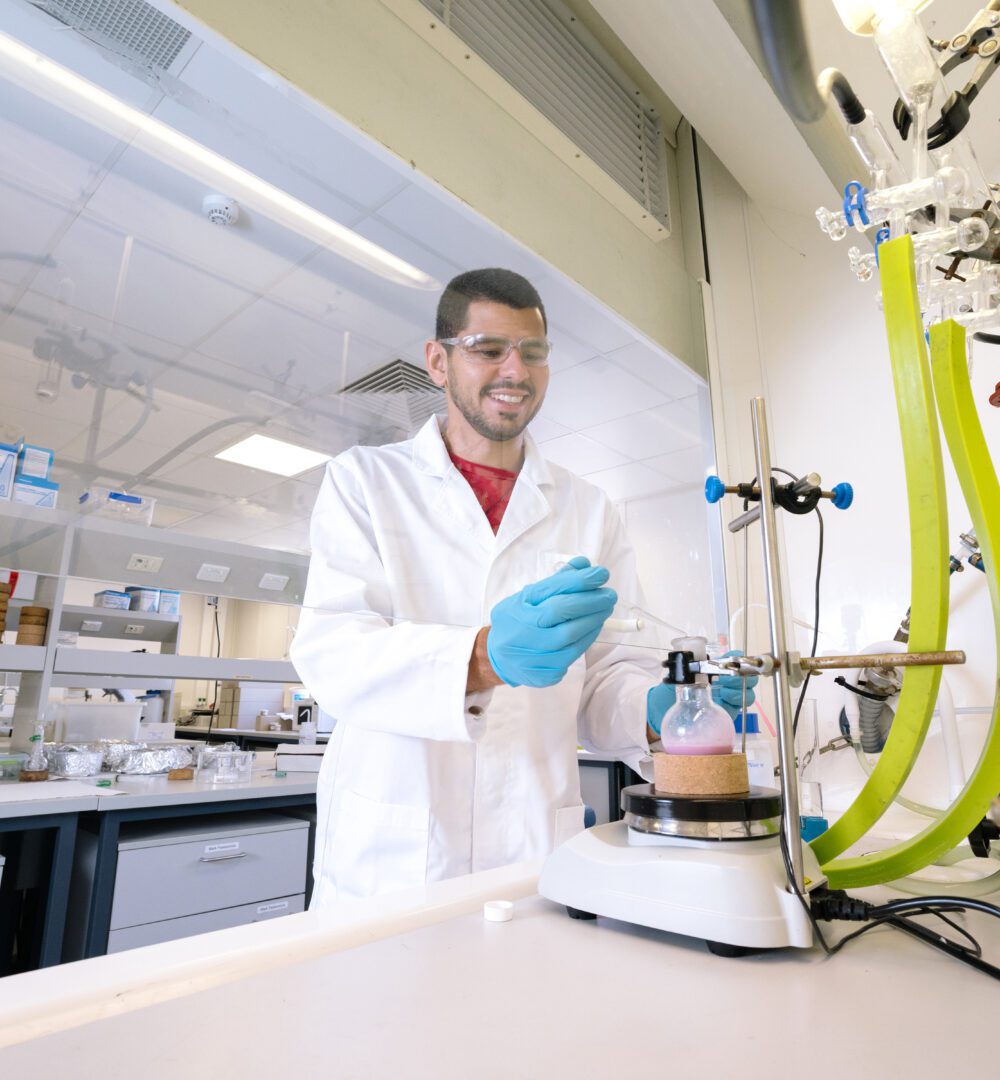
Much of your learning will be based in the laboratories at Curtin’s Resources and Chemistry Precinct. You’ll also develop problem-solving, teamwork and critical analysis skills, which can open opportunities for other careers in science.

You can choose to specialise in one of three areas: Analytical and Forensic Chemistry, Medicinal and Biological Chemistry, or Chemistry of Sustainable Development.

Analytical and Forensic Chemistry

In this specialisation, you’ll learn how to use sophisticated scientific instruments to solve complex analytical problems in forensic and environmental chemistry. You’ll also develop decision-making skills within the ethical and professional context of analytical and forensic science.

Medicinal and Biological Chemistry

In this crossover field of chemistry, you’ll study the essential processes of life at the molecular level. You’ll use complex equipment and procedures to understand the biomolecular world, explore applications in biosensors and drug design, and monitor the effects that new substances have on living organisms.

Chemistry of Sustainable Development

This specialisation focuses on the chemical processes used in local industries. It centres on chemistry's integral role in developing solutions to sustainability challenges in areas such as water resources, energy, industry and the environment.

Chemistry is also available as a Bachelor of Advanced Science (Honours) course.

Double degrees

You can extend your expertise and career opportunities by studying Chemistry as a double degree with Chemical Engineering, ArtsCommerce or Innovation. (Various majors are available within the Bachelor of Arts, Bachelor of Commerce and Bachelor of Innovation.)

How this course will make you industry ready

You'll have the opportunity to undertake industry research projects at the Resources and Chemistry Precinct, which accommodates Western Australia's primary analytical chemistry facility, ChemCentre.

What jobs can the Chemistry course lead to?

Careers

  • Analytical chemist
  • Environmental chemist
  • Industrial chemist
  • Medicinal chemist
  • Synthetic chemist
  • Forensic scientist
  • Materials scientist

Industries

  • Health
  • Forensics
  • Environment
  • Manufacturing
  • Resources
  • Defence

Further study

What you'll learn

  • have demonstrated knowledge and understanding in chemsitry that is typically at a level that, whilst supported by advanced textbooks, includes some aspects that will be informed by knowledge of the forefront of chemistry, GC1
  • can apply their knowledge and understanding in a manner that indicates a professional approach to chemistry, and have competencies typically demonstrated through devising and sustaining arguments (to both specialist and non-specialist audiences) and solving problems within chemistry, GC2
  • understand the constructs of the scientific method and apply these principles in chemistry using digital technologies, GC3
  • can gather and interpret relevant data within chemistry to inform judgements that include reflection on relevant social, scientific, or ethical issues, including being aware of the diversity of international perspectives associated with chemistry, and how these impact upon the practice of chemistry, GC4
  • understand and appreciate cultural diversity and how it impacts on the practice of chemistry, GC5
  • display a high standard of professional behaviour, including effective time management, both independently and as a team member, GC6

Why study Chemistry at Curtin?

Industry connections

You'll can participate in industry research projects at the Resources and Chemistry Precinct, home to Western Australia's primary analytical chemistry facility, ChemCentre.

Specialist pathways

Choose to specialise in Analytical and Forensic Chemistry, Medicinal and Biological Chemistry, or Chemistry of Sustainable Development.

Advanced facilities

Gain skills using the advanced laboratories at Curtin's Resources and Chemistry Precinct.

Professional recognition and accreditation

Graduates are eligible for membership of the Royal Australian Chemical Institute (RACI).

Admission criteria

What you need in order to get into this course. There are different pathway options depending on your level of work and education experience.

Select an option that best suits you:

You’re considered a high school leaver if you:

  • Completed year 12 in Australia or overseas in the past two years, or
  • Completed TAFE or VET studies in the past two years.

ATAR pathway

  • Essential WACE subjects (prerequisites)

    Essential WACE subjects (prerequisites)

    There are no essential WACE subjects for this course.

  • Desirable WACE subjects

    Desirable WACE subjects

    There are no desirable WACE subjects for this course.

Please see our correlation comparability for previous TEE subjects, WACE courses and WACE ATAR courses.

StepUp Entry

StepUp Entry

Successful StepUp Entry and StepUp Equity Adjustment Admission Pathway (StepUp Bonus) applicants will be eligible to be considered for admission into this course.

Alternative pathways

English requirements

Curtin requires all applicants to demonstrate proficiency in English. Specific English requirements for this course are outlined in the IELTS table below.

You may demonstrate English proficiency using the following tests and qualifications.

IELTS Academic (International English Language Testing System)

Writing

6

Speaking

6

Reading

6

Listening

6

Overall band score

6

Find your pathway to Curtin

Think you don’t have the marks or qualifications to study at Curtin? We have several pathways to help you meet admission. Use our pathway finder to find your best way to studying with us.

Pathway finder tool

How others gained admission

View the ATAR breakdown to see the low, median and high ATAR scores of students who started studying this course recently.

To see the other pathways students have taken, see the pathway breakdown.

Application Requirements

You’re considered someone who has recently left university if:

Applicants with higher education are those whose highest level of study since leaving secondary education is a higher education course, such as a university degree. This may include applicants who are currently studying a higher education course at another education provider and want to transfer to Curtin University, or applicants who are currently studying at Curtin but want to switch to a different course. It may also include applicants who have completed past study with university and non-university higher education providers.

English requirements

Curtin requires all applicants to demonstrate proficiency in English. Specific English requirements for this course are outlined in the IELTS table below.

You may demonstrate English proficiency using the following tests and qualifications.

IELTS Academic (International English Language Testing System)

Writing

6

Speaking

6

Reading

6

Listening

6

Overall band score

6

Find your pathway to Curtin

Think you don’t have the marks or qualifications to study at Curtin? We have several pathways to help you meet admission. Use our pathway finder to find your best way to studying with us.

Pathway finder tool

Application Requirements

Unsure what option suits you?

We’re here to help you navigate the complexities of university admission. Choose the support you need from the options below.

Find your pathway to Curtin

Think you don’t have the marks or qualifications to study at Curtin? We have several pathways to help you meet admission. Use our pathway finder to find your best way to studying with us.

Pathway finder tool

Application Requirements

Credit for recognised learning (CRL)

Use your experience to get credit towards your degree

Finish your course sooner with credit for your previous study or work experience.

Fees and scholarships

Please view the Bachelor of Science (Science) degree for indicative fees.

Looking for more detail on the course structure?

View course structure

How to apply

Please review information on how to apply for the campus of your choice

Apply now
  • The offering information on this website applies only to future students. Current students should refer to faculty handbooks for current or past course information.

    The information on this page may be subject to change. In particular, Curtin University may change the content, method or location of delivery or tuition fees of courses.

    While Curtin uses reasonable efforts to ensure that the information provided on this page is accurate and up to date, errors and omissions sometimes occur. Curtin makes no warranty, representation or undertaking (expressed or implied) nor does it assume any legal liability (direct or indirect) for the accuracy, completeness or usefulness of any information.

    View courses information disclaimer.

  • Curtin course code: MJRU-CHEMM
  • Last updated on: 8 March 2026

Got a question? We’re here to help.

Call 1300 222 888 Send us an email Ask us a question Book an appointment

Bachelor of Business Administration (BBA) Specialisations

Bachelor of Commerce Specialisations

Bachelor of Innovation Specialisations

Learn more about Commerce

Apply for Chemistry Major (BSc Science)