For most students, studying overseas sounds exciting. But working overseas is a completely different experience. For Korean Studies student Temarah and Finance student Henry, their New Colombo Plan funded study tour and internship was a five-week immersion in Korean business and culture. | Reading time: 6 min.
Through Curtin’s South Korea internship and study tour program, students spent five weeks of their summer break gaining hands-on industry experience, learning about Korean culture and history, and navigating everyday life in another country – all while earning 25 academic credits. On top of all that, many eligible students were able to fund their adventure with a New Colombo Plan mobility grant, which typically ranges from $4,000 to $9,000 depending on the project’s duration and focus.
Originally created as a core unit for Korean Studies students, the unit has grown into a cross-faculty opportunity open to students from different disciplines. The program is organised by the Korean Studies team, Korean Research and Engagement Centre at Curtin, the Faculty of Business and Law and the Faculty of Humanities – with New Colombo Plan funding facilitated by Curtin Go Global.
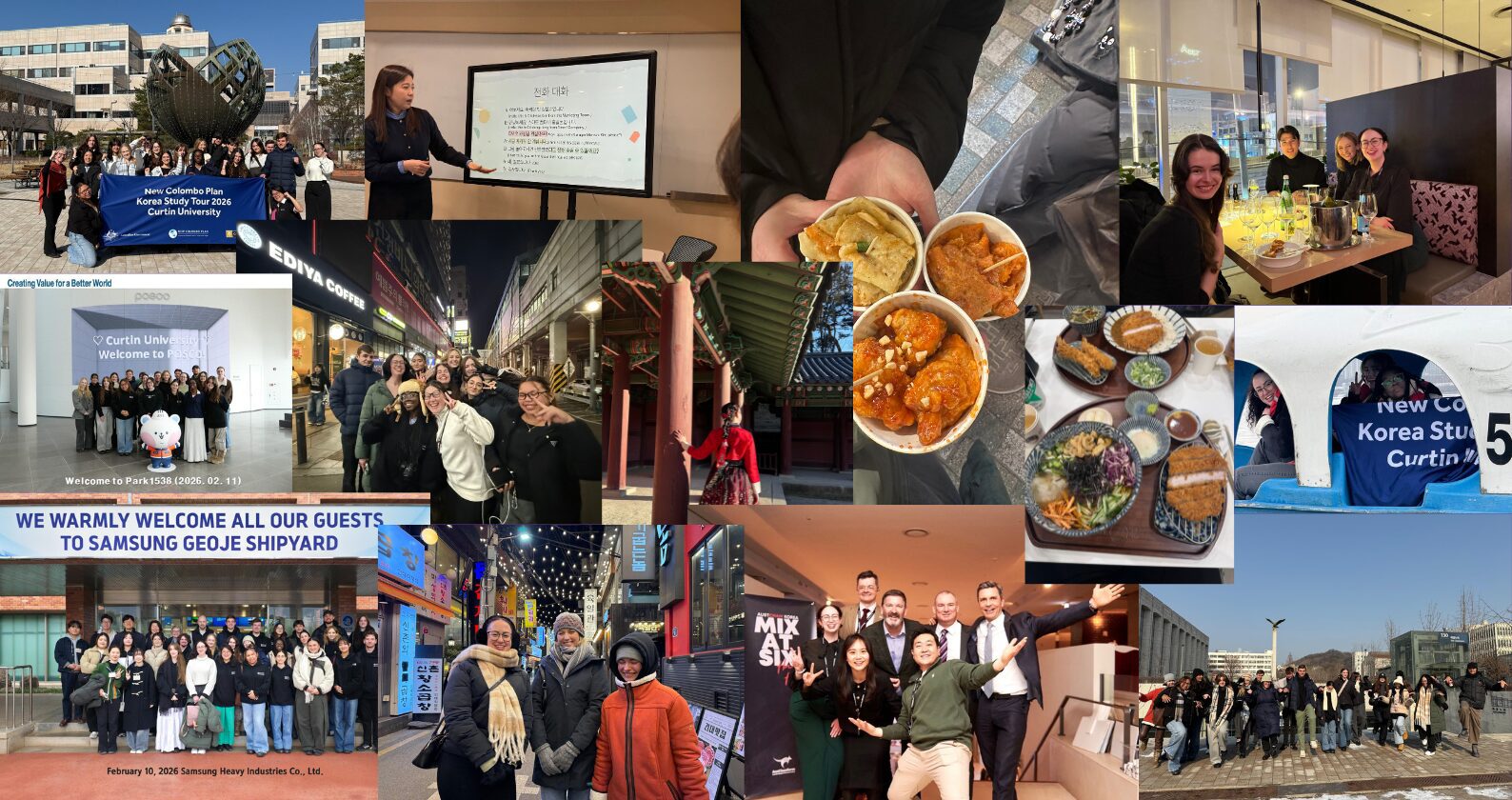
Students completed a five-week program in South Korea combining cultural immersion, academic lectures and internships with Korean companies and organisations – ranging from Samsung Construction and Trade to the International Vaccine Institute to the North Korean Human Rights Research Center and the Australian Chamber of Commerce in Korea.
According to unit coordinator Jo Elfving-Hwang, the goal is much bigger than simply enjoying Korean culture.
“As an educator, one of my biggest gripes about overseas study experiences is that they can sometimes be just another form of tourism. We want students to gain deep knowledge about Australia-Korea relations and consider their differences and similarities. We want them to come out of this study tour with an understanding of Korea matters to Australia, so they can take that with them into their future workplaces.”
Before departure, students learnt about the Korean language, culture and workplace expectations. Once in Seoul, they attended cultural workshops and industry lectures, visited museums and policy institutes, and connected with local university students. The group also travelled to Busan, where they visited the United Nations Memorial Cemetery and paid respect to Australian soldiers who served in the Korean War. Industry visits included Samsung shipyards and POSCO steelworks.
Korean Studies student Temarah found visiting Samsung shipyards in Geoje to be one of the highlights from the whole trip, as it helped her grasp the true scale of Australian-Korean relations and import-export industries.
“To see some of these huge ships that were getting built as we went through the shipyard was incredibly impressive. It made the industry connections between Australia-Korea seem very real and tangible.”
Then came the internship experience itself.
International relations student Henry describes his experience as life-changing. Completing his internship with Samsung Construction and Trade, Henry worked with a team focused on the Australian energy market, giving him a practical understanding of concepts he had previously only studied in class.
“Being part of Samsung allowed me to see how these huge Korean companies actually operate and how workplace culture functions inside those institutions. It was a really good exploration into everyday life.”
For Temarah, her internship at the Australian Chamber of Commerce in Korea opened her eyes to how many Australians were working in the Korean business and diplomatic space, and how much opportunity there is. Working at mixed language meetings and large networking events, gave Temarah more confidence in her Korean fluency, and professional connections who now ask when she’s returning to Korea.
“I was put on the front door at an industry mixer, which felt like a ‘sink or swim’ kind of situation! But it was something that made me think, if I ended up back in Korea, I’ll have good business relations here.”
Henry found the biggest learning curve wasn’t the long work hours or the work itself, but adapting to the completely new environment.
“Integrating into the culture was a big process. We learned small gestures, practices and phrases before we got there so we could interact respectfully with our co-workers and show our appreciation non-verbally.”
Living in university accommodation alongside Korean students also helped immerse students in everyday life. For Henry, one of the most valuable parts of the experience was interacting with people he otherwise never would have met.
“Getting to build connections with people from a completely different culture was definitely my favourite part.”
The study tour was designed to push students outside their comfort zones in a structured way, with the support of their peers. Academic staff like Jo were there to give advice on Korean cultural practice and suggest academic literature to students for them to go and find out themselves.
For Jo, working through culture shock is part of become a global citizen – realising that the different ways of seeing the world are all equally valid is where the learning happens. To enhance this learning, students also kept a reflective journal throughout the experience, analysing how they responded to unfamiliar situations and cultural differences.
“Difference is not always fun but it doesn’t have to be. Your response as a higher education student shouldn’t be to judge, but to use your research skills and adaptability to make sense of it.”
Thinking about taking part? Henry and Temarah have some tips to pass on.
- Learn some Korean language before departure.
- While you’d be able to survive the trip without speaking Korean, being prepared leads to so much more learning.
- Henry wasn’t able to fully learn the Korean language before he went, but using his limited Korean led to much more genuine experiences with people and allowed him to more deeply connect
- Understand Korean culture and business structures
- As an Korean Studies student, Temarah found her knowledge of Korean business structures and etiquette like paying due respect to superiors allowed her to come across as more professional in her internship.
- Budget more than you’re expecting
- While the cost of accommodation and flights can be fully covered by a New Colombo Plan mobility grant, Henry advises to budget for the general cost of just everyday life and extra activities. “When you’re really enjoying yourself in another culture, you might end up spending a bit more on things you want to try while you’re there.”
- Bring some cash and get a T-money card for transport in South Korea
- Henry suggests doing some research, but notes the transit system is amazing and the process isn’t too difficult. “You’ll want to use it as much as you can!”
- Keep an open mind and just do it.
- Henry says he has absolutely no regrets. “Being able to study and intern abroad is really challenging to organise on your own, and this study tour made it much easier to achieve. I got to be an intern in South Korea! In my eyes, that’s a great use of 25 credits.”