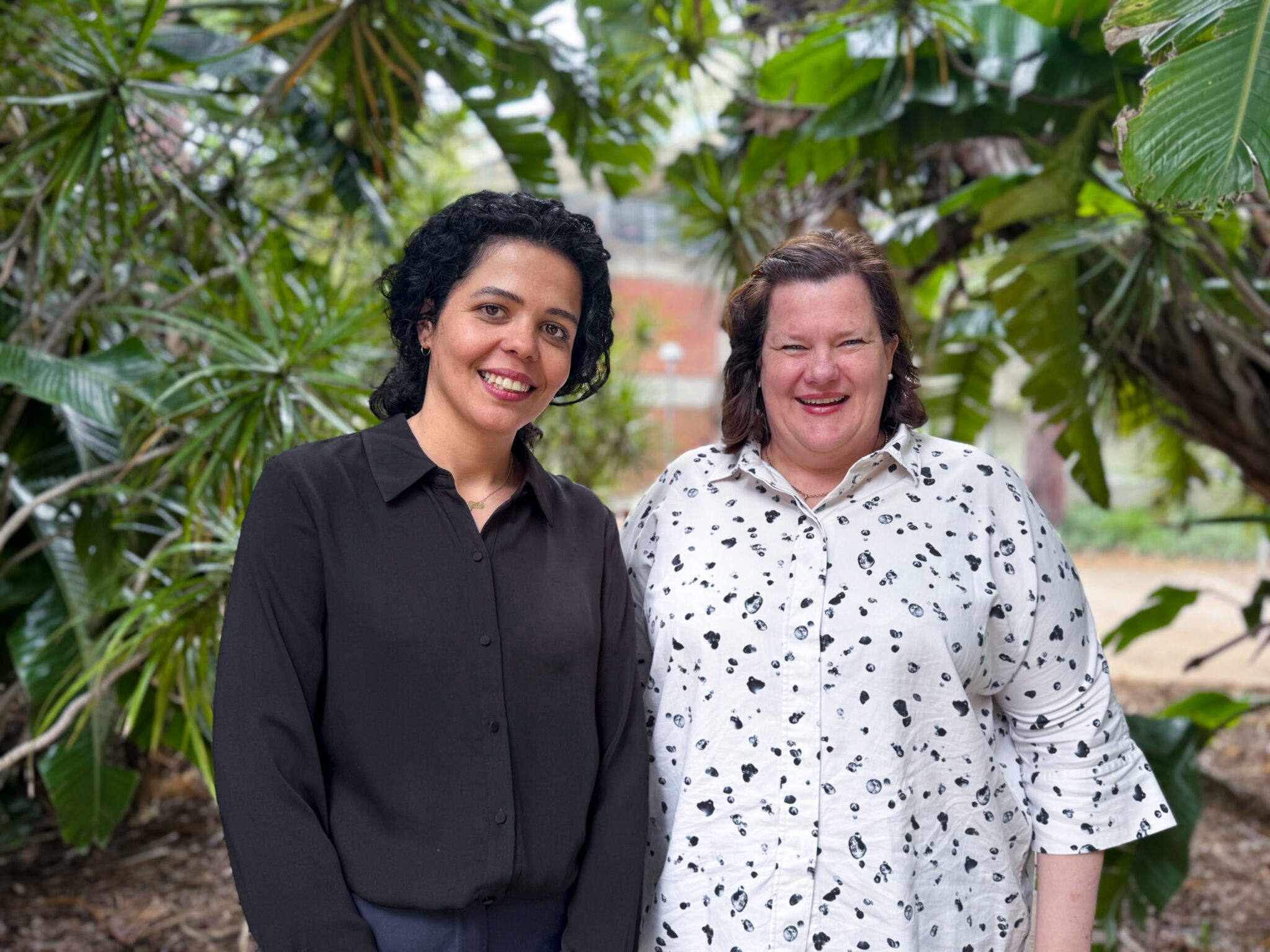
With an MPhil in Technology Management and inspired by her family’s farming background, Shila’s research sits at the intersection between agri-food supply chains and AI. With her supervisors’ guidance, she hopes to make a difference in the agriculture industry. | Reading time: 6 min
Shila’s desire to bridge the gap between technology and agriculture was no easy undertaking. With her supervisors’ guidance, she hopes to make a difference in the agriculture industry. Shila and her main supervisor, Associate Professor Elizabeth (Liz) Jackson, reflect on their challenges and achievements during their supervisory relationship so far.
Shila
My PhD explores how artificial intelligence can strategically be applied to drive sustainable transformation in agri-food supply chains. I focus on identifying the capabilities organisations need to leverage AI effectively and how these capabilities can improve their resilience, competitiveness, decision-making process and alignment with the sustainability goals.
What I hope to achieve is a deeper understanding of how AI can be meaningfully used in agriculture. It’s not just about developing smart technologies; it’s about making sure that the people working in the field are truly empowered.
I want to bridge that gap between what technology can do and what’s happening on the ground. If my research can help make agricultural practices more sustainable and make a difference, I would consider that a real success.
My journey toward a PhD started long before I even knew what research was. My dad grew up in a farming family, and when I was a kid, he was always telling me about the problems they had in the traditional farms, with their animals, the conflicts between farmers over watering plants, and this kind of stuff.
Later, I studied technology management and worked in the industry for a couple of years. I love coding. It’s like solving a problem every day. But after that, I found that we could use these kinds of codes and technologies in the field and help people live more easily and solve their problems. After that, I realised I wanted to go beyond building solutions for short-term problems.
I wanted to explore how technology could create real, lasting change. Agriculture felt like the most natural place because it connects deeply with my roots and the stories I grew up hearing.
My supervisor journey was a bit complicated at first, because I needed a mentor who really understood the technology, agriculture, and the connection between the two. Liz has a deep knowledge of the supply chain and agriculture. Shimul also has another way of thinking about our problem, which helps me understand how I should structure the problem, how I should analyse it, and how I should find the answers to my research questions.
AI in agriculture is so broad that breaking it into smaller pieces while keeping the research meaningful was a bit challenging for us at first. I’m also new to Australia, new to Curtin, and new to the agriculture here. The combination of all of this made it a bit challenging. But being able to research something I’ve always been passionate about and do something meaningful makes all these challenges worth it.
For me, finding supervisors who truly believe and trust in me, despite all the challenges, is a big achievement. And passing my M1. This is really the life that I have always dreamed about.
Liz
In agri-food supply chains, there is more and more automation, and this is stretching into artificial intelligence systems. Shila’s research is aimed at looking at how artificial intelligence, as an extension of mechanisation, is making a difference to firms in the agri-food supply chain systems all over the world.
Shila started with us at Curtin as an MPhil student. So, having done extremely well as an MPhil student, she was eligible to upgrade to a PhD because of her background. And while that’s been a lot of work, she passed M1, so she’s now an official PhD student.
I just had a gut instinct that Shila was going to be a very good student and a delightful student to supervise over three to four years. I would say I care deeply about the student experience and my students’ career prospects. I try to set my students up for a challenging yet rewarding student experience so they have something they can see past the end of their PhD to the next stage of their career.
I do enjoy working with other people who have that intellectual, theoretical side, because my style is very much linked to my industry engagement; that’s what I bring to the table, as opposed to that strong methodological or theoretical aspect.
That’s why we work as teams, because everyone has their own strength. When we bring those strengths together, they make something mighty and something that hits my points of motivation, building students to go into a career after they’ve finished at Curtin.
A major challenge we’ve faced so far in the research has been the research design. The whole team lost so much sleep over balancing what is achievable and what is necessary for a PhD-level qualification. We hit so many roadblocks in terms of what is possible about data collection. It took a couple of weeks of hard thinking, extensive testing, and calculations to ensure that what was being designed was an achievable yet rigorous research study.
One of the strategies that I’m particularly proud of that Sheila has implemented to overcome her newness is not being afraid to make friends and take opportunities wherever they present themselves, not only within the university but also outside it. Shila and I have attended a couple of agribusiness events together, and she’s always been very welcome in the industry.
Shila was also the only person from the Business School to attempt the three-minute thesis competition and came in third place. An achievement like that, so early in someone’s candidature, is most impressive. And having the courage when English isn’t your first language and speaking in public isn’t one of your strengths was absolutely exceptional.
One of the things students have that their supervisors often don’t is time to reflect and really soak up new knowledge. So, I consider students are blessed with that time. It’s nice to let them enjoy the time they have, because when they finish, it won’t be quite like that anymore.

Shila Khademi Sharifabad
Shila is currently researching how artificial intelligence can accelerate sustainability in agri-food supply chains, sitting at the crossroads of AI, systems thinking, and real-world supply chain complexity. Before research, she spent several years in industry, leading data-driven transformation as a Business Analyst, Supply Chain Analyst, and Procurement Specialist across sectors. Shila also teaches Strategic Management, Supply Chain Decision Analytics, Supply Chain Planning and Design, Business and Sustainable Development.
Dr Elizabeth (Liz) Jackson
Liz is an Associate Professor of Supply Chain Management and Logistics in the School of Management & Marketing. Liz joined Curtin in 2017 after working at Newcastle University and the Royal Veterinary College in the UK. Liz teaches supply chain management and logistics to MSc students and researches digital systems in agri-food supply chain systems.