What do your liver, stomach and heart have in common with a fish?
It might sound like a tricky trivia night question but according to Curtin palaeontologist and evolutionary biologist, John Curtin Distinguished Professor Kate Trinajstic, the answer is: probably more than you realise.
For more than thirty years, Professor Trinajstic from the School of Molecular and Life Sciences has been searching for clues about how vertebrates, including humans, evolved, helping to piece together the story of our origins.
Placoderm fish
While one breakthrough might be enough to define a career, Professor Trinajstic’s research has contributed to several milestones in our understanding of evolution.
Her work is centred on the placoderm fish – an extinct class of armoured fish that are among Earth’s earliest jawed vertebrates.
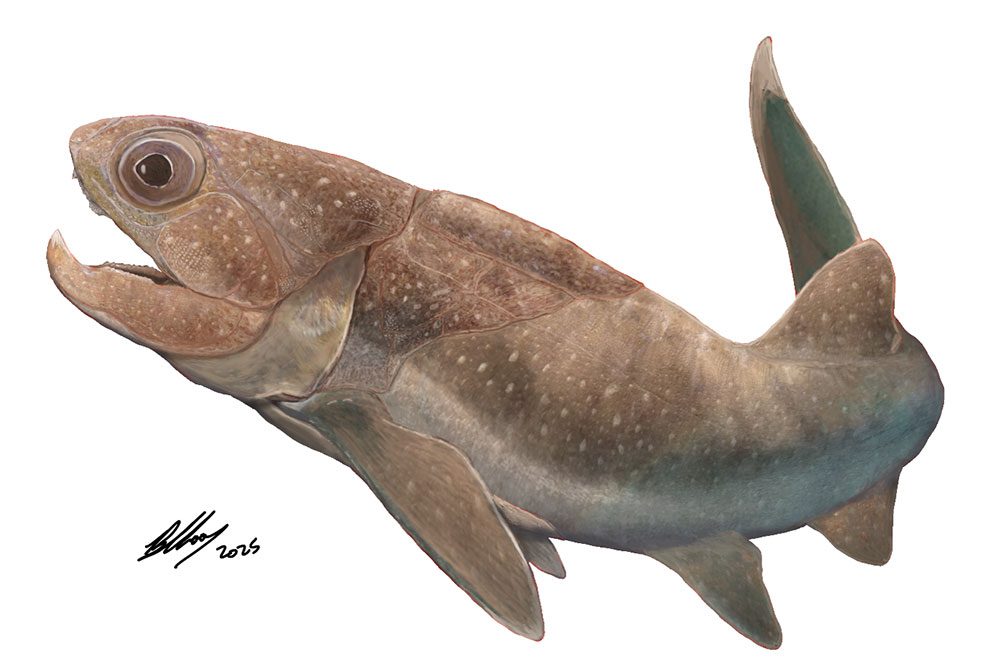
Credit: Brian Choo/Swiss Journal of Palaeontology
Placoderms once ruled the ancient seas, including the tropical reef systems that existed in what is now Western Australia’s Kimberley region, before a mass extinction wiped them out.
Fortunately for scientists, those reefs left behind an extraordinary fossil record, and millions of years later, they would become part of what is now known as the Gogo Formation.
Few fossil sites hold evidence as clearly as the Gogo Formation, where ancient fish have revealed everything from internal organs to the earliest evidence of live birth.
“When we think of our evolutionary origins, ancient fish are probably not the first animals that come to mind,” Professor Trinajstic said.
“We often picture our closest relatives, such as chimpanzees or other primates, but many of the anatomical features humans have today, including our jaws, stomach and paired limbs, can be traced back to the jawed fish – like the placoderm.”
In 2022, Professor Trinajstic and her collaborators made international headlines after identifying the oldest known 3D preserved heart from a jawed vertebrate found in the Gogo Formation.
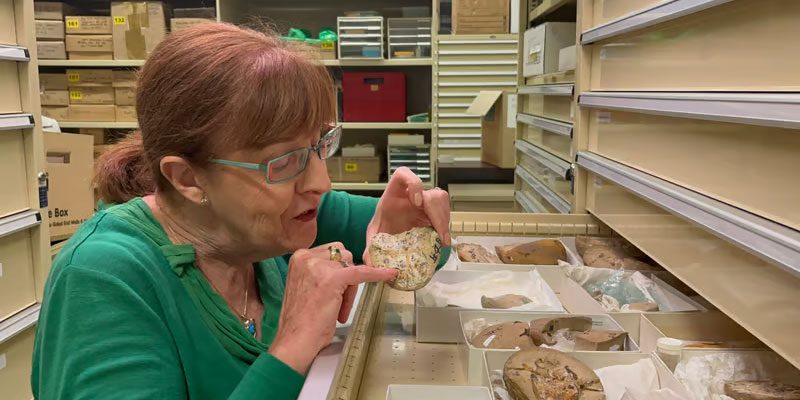
Hidden inside a 380-million-year-old placoderm, the fossil offered the first detailed view of a vertebrate heart in remarkable detail.
And it wasn’t the only surprise. The team also found a perfectly preserved stomach and liver, revealing internal anatomy that is rarely recovered in fossils.
“For the first time, we saw how several major organs of a jawed fish were arranged together inside a jawed fish, and we were especially surprised to learn that they were not so different to us,” Professor Trinajstic said.
The find was only made possible by utilising sophisticated imaging technology including synchrotron scanning at the European Synchrotron Radiation Facility (ESRF) in France and neutron tomography at the Australian Nuclear and Science Technology Organisation (ANSTO) in Sydney, which allowed them to look at the fossil non-destructively, while still embedded in the rock.

“In the past, the only way to get rock away from a fossil sample was to either manually cut the rock away or put it in acid,” Professor Trinajstic said.
“However, both techniques would destroy any soft tissue preservation.”
“Not only that but soft tissue usually decays long before it gets the chance to fossilise, so this was an incredibly rare find.”
“It’s a unique window into a critical stage in the evolution of the vertebrate body.”
“What you look like inside can be traced back hundreds of millions of years – far earlier than we ever thought,” Professor Trinajstic said.
A fishy surprise
One of the earliest breakthroughs she contributed to came in 2008, when a team led by Professor John Long from Flinders University uncovered the earliest known evidence of live birth in vertebrates.
While the fossilised heart would later capture global headlines, Professor Trinajstic said the embryo discovery remains one of the most surprising moments of her career.
The fossil revealed that vertebrates gave birth to live young far earlier than scientists had previously thought.
“It was so unexpected that colleagues didn’t believe us at first,” Professor Trinajstic said.
“The heart was a great find, but we knew jawed vertebrates had a heart – we had just never seen it in such detail before. But the embryo came as a complete surprise to us.”
Still more to discover
For Professor Trinajstic, it’s all part of a much larger story.
“One answer leads to five more questions,” Professor Trinajstic said. “That’s the exciting thing about science, though.”
Whether she’s revealing the earliest evidence of live birth, or uncovering ancient organs, each new find has added another piece to the puzzle of our evolutionary history.
So, if ever this question pops up at a trivia night, you’ll know the answer in remarkable detail.
– – –
This piece was featured in Impact Focus – a quarterly newsletter bringing you the latest in Curtin research. Sign up here to get it delivered straight to your inbox!