Reading time: 3 minutes
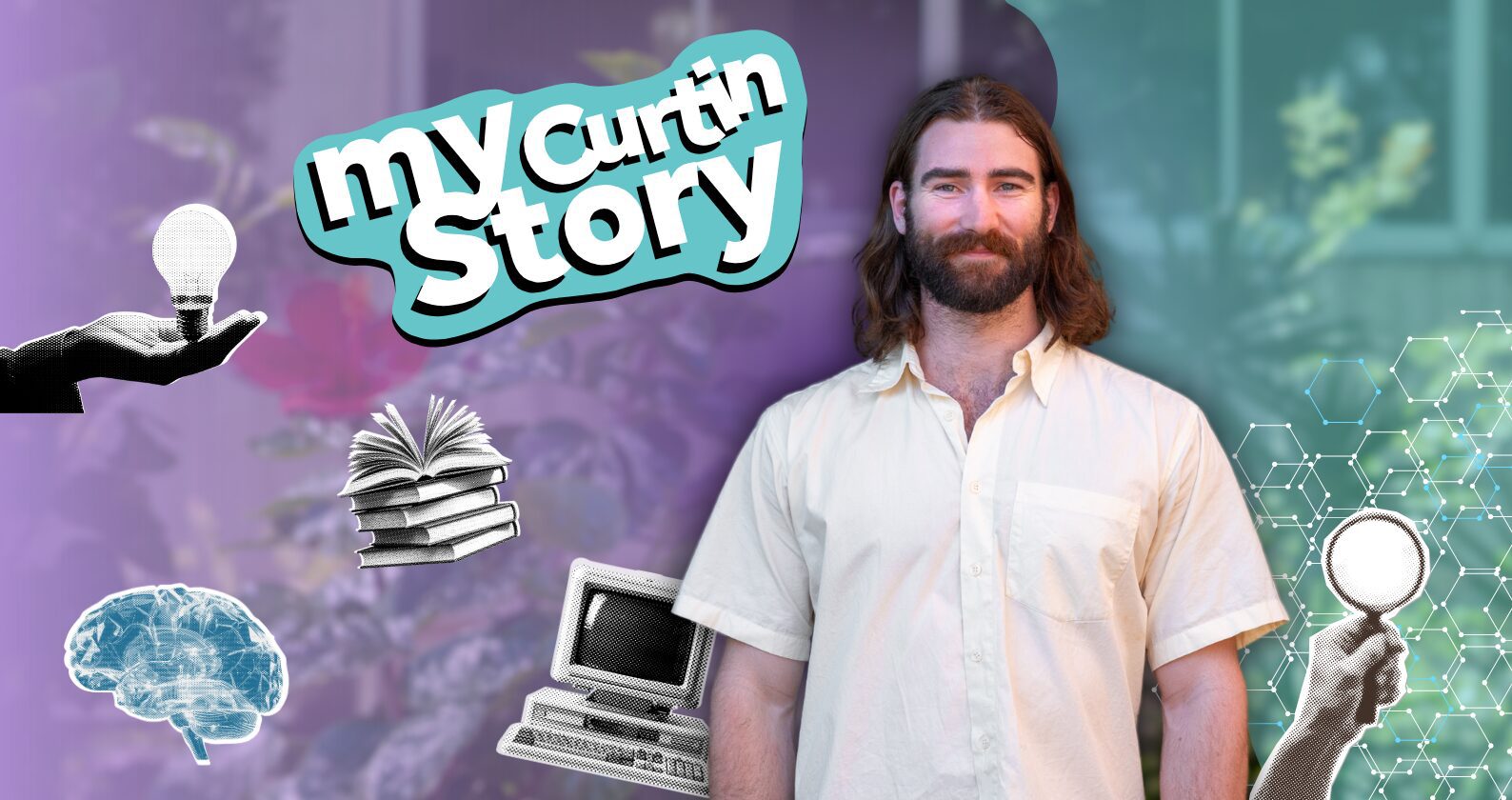
How can new ways to visualise research impact psychology academia? After undertaking a Summer Internship at the Curtin Hub for Immersive Visualisation and eResearch (HIVE), Michael has found his experience academically enriching and hopes to continue exploring other areas of psychology, leveraging his newfound skills in visualisation.
Michael started at uni as an undergraduate in exercise science. But when he realised that exercise programs are not often prescribed for psychological reasons, he felt that an understanding of behavioural change could help build these programs more effectively. This led him to study psychology.
Now a PhD student, he completed an internship at Curtin HIVE, which helps research-driven students communicate their findings in new and innovative ways through immersive visualisation and simulation. As a Summer Intern, Michael took on a challenging research project using high-tech resources, supervised by leading researchers and supported by HIVE Visualisation Specialists. Despite the intensity, he found the internship incredibly rewarding for developing his technical skills.
“Within each program and each component of the overall paradigm that we were trying to build, there was a lot going on. Building something and putting an idea into practice requires a lot of ingenuity and awareness of different tools, such as programming skills. It was humbling.”
While students may apply for an existing project under the HIVE Summer Internship program, Michael applied for the internship with his own project idea. He was inspired to apply at the end of his honours degree when his honours supervisor was researching a model of consciousness and seeking ways to test it. They landed on the idea of creating an immersive complex environment to visualise the model.
“We were having a discussion of what it could mean to test this phenomenon. So we had this novel idea that we’d collaboratively discovered, and we wanted to see if we could build it.”
Despite coming from a psychology background, with little to no experience in visualisation tools, Michael was optimistic about his ability to “just figure it out”.
“I’m comfortable with learning. And a good HIVE Summer Intern is someone who is very eager to learn and okay with not knowing how to do something.”
Beyond learning visualisation tools, Michael has now said that the internship has helped him professionally and academically.
“I learned from Wesley Lamont, the technician supervisor, that when you’re building something new, it’s beneficial to build it to a minimally viable prototype research design and then test it iteratively within the context you want to work it into. That was really helpful because I translated that same learning directly to my PhD.”
One of the highlights of Michael’s HIVE experience was the presentation day.
“It was really nice to see how far everyone had taken their individual projects. And then we all got to showcase that to one another. I really enjoyed that.”
But Michael’s paradigm, which he developed during the HIVE program, is now also being used by other psychology students whom he co-supervised. This data has now been published in a journal.
“The fact that it was useful and we’re still using it is really tangible. I got to experience the teaching side of things with that as well. Being able to share with the academic and scientific community was great.”
Michael’s biggest piece of advice for students looking to apply for the HIVE internship is to really care about visualisation, as that’s what HIVE is all about.
“You will have an opportunity to be innovative in the way in which you present visual information. The project will embody that, and you’ll have the opportunity to learn that. And then you can use that for further innovative visualisation ideas.”
Want to undertake a paid 10-week Curtin HIVE Summer Internship like Michael?