This internet browser is outdated and does not support all features of this site. Please switch or upgrade to a different browser to display this site properly.
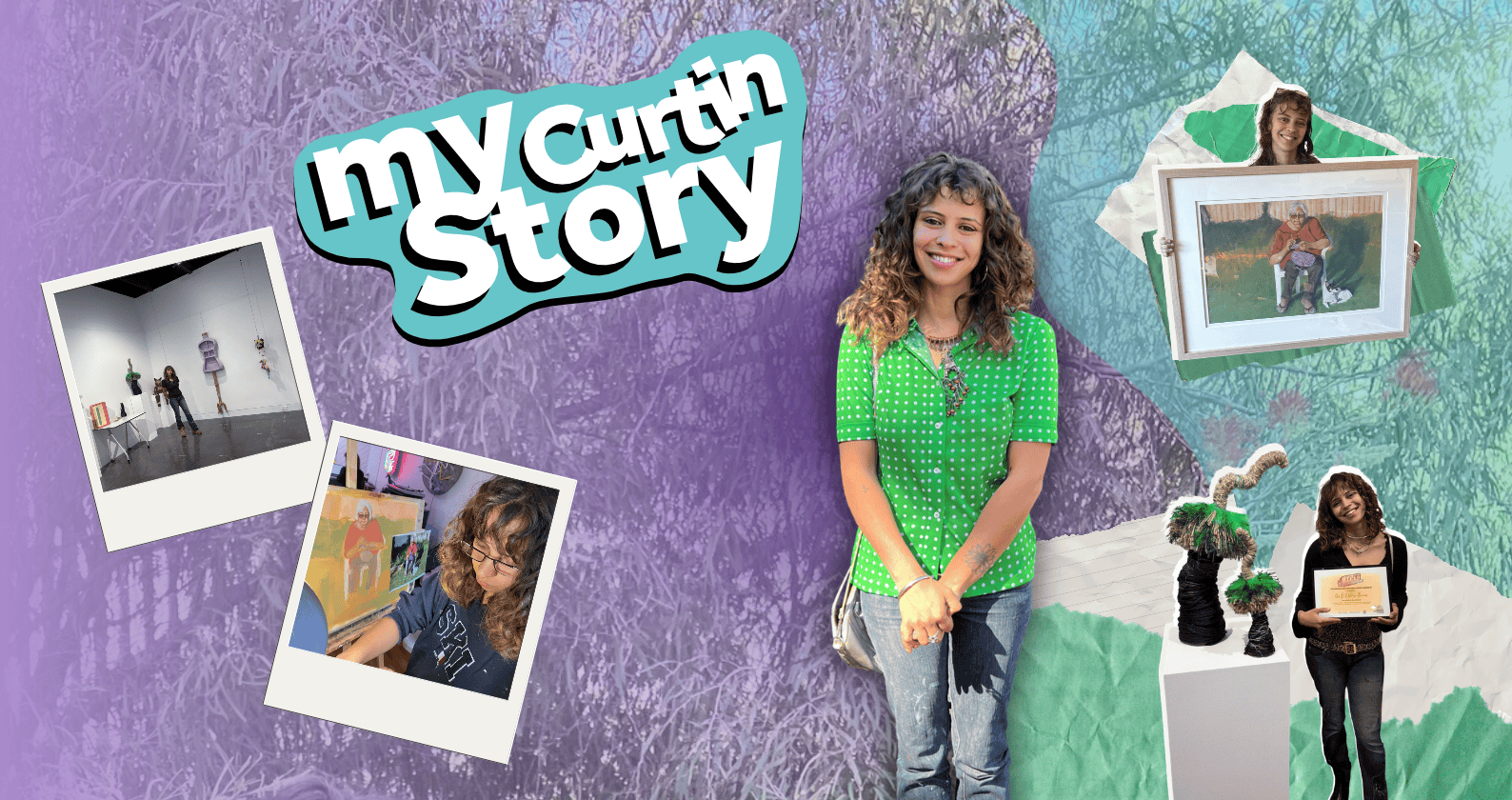
How does a first-year fine arts student become a finalist for the Lester Prize? Meet Lily, a fine arts student and Lester Prize finalist. | Reading Time: 3 Minutes
Growing up among a family of artists, Lily has always been surrounded by creativity. Now studying fine arts, she’s a finalist for the 2026 Lester Prize and is excited about her degree and pursuing an art career.
When Lily first started at Curtin, she was studying psychology, but couldn’t quite find her “place”, not feeling it was the right fit for her. She realised her passion lay in art, leading her to pursue a Bachelor of Creative Arts with a major in Fine Arts. In her first year alone, she’s already found that she is much better suited to the degree.
“It’s just been completely different. I’ve made friends in all different classes, and it’s a happier, community vibe, which I really like.”
As a First Nations student, Lily has been influenced by her Nana, Laurel Nannup, a Noongar woman who was part of the Stolen Generations.
“Seeing my Nana, all her art is about her life experience, so that’s always inspired me to put a bit of my culture into my work and also speak my truth.”
Lily has been selected as a 2026 Lester Prize finalist for a painting of her Nana that depicts her experience with Alzheimer’s from Lily’s perspective.
“Even though she’s changed quite a lot physically – she’s not the big chunky woman she used to be – she still laughs the same, and is cheeky, and when I look at her, that’s what I see.”
Lily’s Nana, one of her biggest inspirations, was a printmaking artist and truth-teller.
“That really inspires me, just the fact that she tells her story through art. I think that’s one of the most important things you can do, you can speak to things through your art.”
Lily tries to imbue all the work she creates with meaning so that she can actively contribute to conversations about First Nations culture through her art.
“I just want to try and put meaning into everything I do and show that I’m very strong within my culture; I feel like that’s another thing that this degree is inspiring me to do, to be more confident in my culture and to be proud of being a young Aboriginal woman.”
Though Lily struggled in school, having dyslexia and ADHD, she’s found that being in a class surrounded by other students in creative arts has helped her gain confidence in her learning. She’s also found that being taught by current practising artists has supported her learning and aligned with her goals.
“Practising artist teachers really help in that way because they can give you that live feedback. They know what it’s like to be currently in art, to be a contemporary artist.”
Since starting at Curtin, Lily has found even more passion for becoming an established artist.
“I am able to express myself visually, and even though I have my learning disabilities, that doesn’t affect me through my painting or my sculptures. It’s given me a really powerful way I can tell my story or my beliefs and put a little bit of politics in here and there.”
Lily strongly recommends that other First Nations students considering the degree study fine arts.