Reading time: 6 minutes
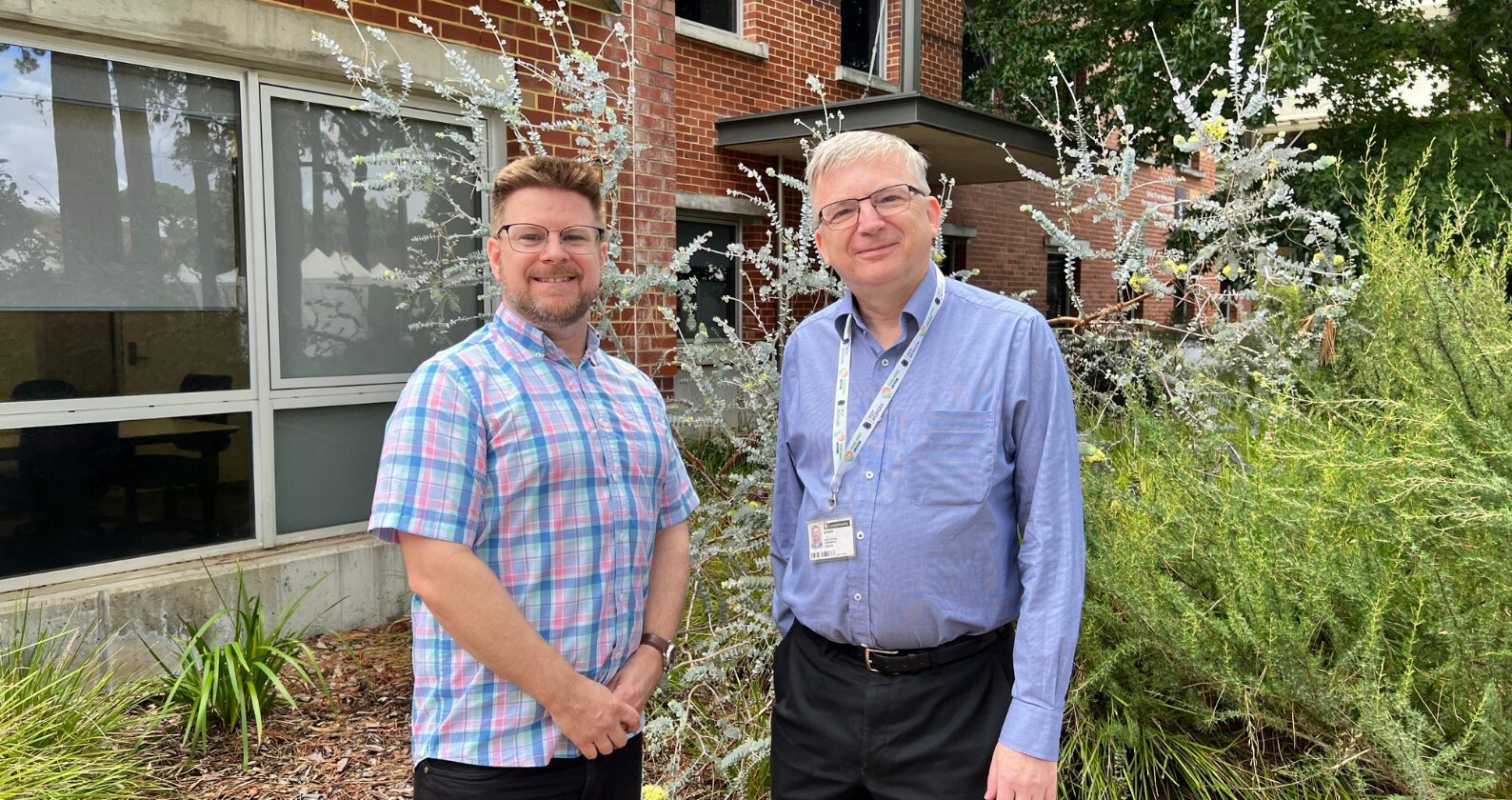
Jonathan and David look back on their supervisor-supervisee journey so far.
Jonathan:
I am looking at the lived experiences of gender de- and re-transition, under the School of Population Health. With one of my co-supervisors, Katrina Davis-McCabe, I did a project in my Master’s, before moving into a PhD, that was looking at the lived experiences of transition in Australia. This PhD, under the guidance of Sam, David and Katrina, is an extension of that and looks at the lived experiences of people in Australia who transition more than once.
There’s been this wave of research, interest, knowledge and cultural awareness about gender identity, trans experiences, and transitioning. In the last 10 to 15 years, there’s been a huge avalanche of information and discussion on that topic more than ever before. Not all that awareness has been positive, so in the socio-political landscape, the experiences of trans people and health services available to trans people have been really in the spotlight.
My end goals of my PhD would include getting one of, if not the very first, set of insights on the Australian experiences from this population, as well as then being able to set a path for potential guidelines for health and mental health professionals about working with people who are considering or engaging in de- or re-transition.
I started at Curtin in my undergrad in February 1998. I did my undergrad in psych, went off and got registered, came back and did my master’s in psych at Curtin in the 2010s, and then came back to do a PhD. I had started working as a clinical counselling psychologist and then started to teach, but a PhD was always in the back of my mind.
Still involved in the Curtin zeitgeist, I was getting emails in late 2021, and there were a couple of scholarships up for grabs that were linked to particular projects for PhDs. So I sent in my expression of interest, but I explicitly said to them that I can only do part-time. It came back, said ‘No, you were not successful,’ so I just wrote back to Sam and said I’d love to come chat sometime about other projects or opportunities because I’m now teaching, and I’m very interested in a PhD. We caught up for coffee a few times over the next couple of months with Sam, and then with Katrina.
By March, I had filled out my paperwork, so about five to six months of just conversations and coffee to devise and design the idea. Sam presented me with two ideas beyond those scholarships, and I chose this one. Though Sam has retired, he’s still involved.
David has now taken over as principal, and we also have Katrina Davis-McCabe as a co-supervisor. She used to teach psychology here as well, but she’s now at Cannes Miller Institute. She was also previously chairperson of the Australian Psychological Society, so she’s a good name to have on board.
Having studied in various classes at Curtin for many years, and then working at two other universities, the PhD student experience at Curtin has been phenomenal. Everything has been incredibly easy and straightforward. I’m genuinely surprised by how good it’s been.
I know the whole point of a good PhD research topic is that you’re meant to find your little unique corner of the research world, but this is genuinely one of those. No one’s done what we’ve done in Australia in terms of how we’ve collected our data, the interviews we’ve done. It’s not the biggest project in the world, but it is genuinely unique. And that’s something I’m actually really proud of.
David:
Over the last 10 years, the issue of mental health and well-being amongst young people who are experiencing gender dysphoria and transgender young people has become a really significant issue. People have a range of experiences, and there can be a range of factors that are involved in young people’s lives. It’s important that we look at those stories in a more nuanced way, which is why it’s exciting to be involved in this project and what Jonathan has been trying to do from the outset.
I would like to think of my supervisory style as tough but fair, but I think it’s up to the students to comment on that! It has to mean something to complete a PhD. But at the same time, you want to recognise that the whole point is to develop the people’s skills to be able to do this sort of work. We want to transfer as much of what we know to the next generation to be able to take over leadership positions.
Jonathan is unquestionably very passionate about the topic and passionate about research in general. There’s no question that he has the capability to be able to do this sort of work. The ideal candidate is someone who’s already interested and likely to pursue that sort of work as a career, and you can see he has the capability to do it.
I think we always knew that this was going to be a high-risk project in an area that’s very politically sensitive. Some of the rhetoric in the area is particularly strong, to say the least, and can be very hurtful to people. From a mental health perspective, this is an issue that is meaningful to people who live in this community, and there are people in the community who have been very hurt and people who are genuinely afraid about what the future holds for them. We have to try to be as compassionate as we can in dealing with that.
Jonathan has been exemplary throughout the experience, and fortunately, not all PhD students have to go through things like that. I think as I get older, it is really positive when you work with younger people to see not only the enthusiasm that they have, but the new ways that they think about things.
There are always new things to learn and new perspectives that, if I just stayed in my bubble, I would never get to experience. Jonathan has always had a very positive attitude toward everything that happens. It’s really inspirational to have a student who, even when the project gets challenging, is able to say, I’m sure this is going to work out.