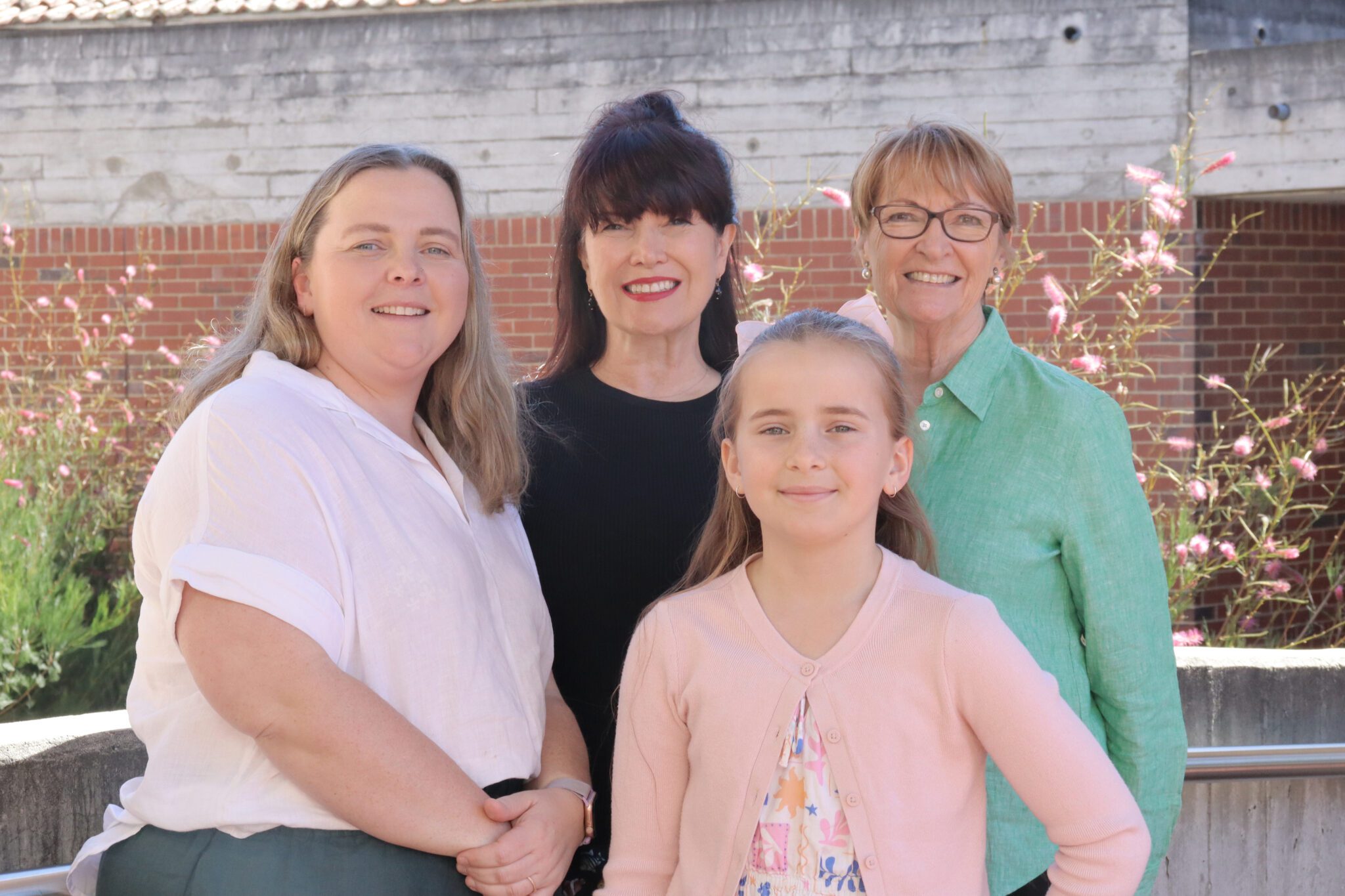
For 40 years, Professor Janet Beilby has helped thousands of Australian children and adults to manage their stutter as director of the Curtin Stuttering Treatment Clinic.
Her work has been so life-changing for many that when she recently ran into a mother and her daughter, the latter of whom Janet had treated for stuttering as a child, the mum was overcome with emotion.
“She was so excited and saying to her daughter, ‘Remember the bumpy talking, darling? Remember?’” Janet recalls.
The daughter, on the other hand – now a teenager – had no clue who Janet was and found the whole scene rather embarrassing.
“The mum was devastated that she had no memory of the therapy!” Janet laughs.
“But I was celebrating, because she had just got on with life. And that’s the best message that I’ve done a good job.”
Janet’s dedicated work as a speech pathology clinician, educator and researcher in Curtin’s School of Allied Health reached a new high this year when she and her colleagues confirmed a genetic link to stuttering.
That is, stuttering is not caused by childhood trauma or anxiety as commonly believed, but by genes – 48 in fact.
If a child inherits some of these penetrant genes from either or both parents, it is likely that they will develop a stutter.
The research was published in Nature Genetics in July and has made headlines worldwide. With a simple saliva test, clinicians can predict which family members are likely to experience the speech disorder that affects 400 million people globally.

For Janet and her colleagues, it means they can start intervention early and help mitigate the impact stuttering has on a person’s confidence, social life, employment and wellbeing.
We unpacked this life-changing research in our latest podcast episode, The Future of Speech: stuttering, genetics and intervention. Below, we highlight just some of Janet’s career as a pioneering speech pathologist who has helped so many people to find their voice.
Q. You’ve committed yourself to a lifetime of speech therapy. Where did it all start for you?
A. It started in the early 80s when I was a speech pathology graduate at Sir Charles Gardiner Hospital, where we ran an outpatient clinic for adults who stuttered.
These people were phenomenal, but they were really hurting. We were doing pretty draconian speech therapy back then – it was fluency at all costs – because we thought that was best practice. But it never sat right with me.
It shouldn’t get to the point where stuttering is left to consume so much of a person’s waking life.
So, I was then offered a job at Curtin and through that I travelled to the US on a research scholarship, where I was able to turn my attention to early treatment for stuttering. I worked with some very prestigious researchers at the University of Arizona, and I came back to Australia with great conviction, and it’s been a rolling stone ever since.
But I have to say that I’ve been drawn to this profession because it’s all about relationships.
Relationship building has been instrumental in my work. The worst researchers are those who have no interpersonal skills!
You’ve got to be approachable and happy to cooperate and work with people. And I think that’s the essence of this therapy and work. You’ve got to be kind and want to be caring in your working life.
Q. Tell me about some of work you do with children who stutter at the Curtin clinic.
A. I have an excellent PhD student, Rachel Michael, who is conducting research into school aged children who stutter, because 100% of these children are bullied. So, our responsibility is not only to help their fluency but to help their psychosocial needs as well.

We do that through programs that help a person feel that they are not defined by their stutter; it’s just one facet of them.
So, it’s not about ‘fixing’ someone, it’s about negotiating with that individual about what they want and need.
For example, we’ve devised the Curtin Stuttering Treatment Program, which incorporates a resilience package, modified from the Triple P Parenting course, into the therapy for stuttering. The package encourages more autonomy in children such as by giving them chores and increased responsibilities, and pulls back on empty, vacuous praise.
It’s based on some very interesting work from Russ Harris called Acceptance and Commitment Therapy (ACT), whereby he says you don’t want a ‘happiness trap’ – you don’t want to keep young people happy all the time. What you want is for them to be well-adjusted adults, and that means having resilience to deal with life and all its adversities.
So, if a young person or adult does stutter, you teach them to stay in the moment, get a little grounded and then move on. ACT takes away the struggle, and when you eliminate the struggle, the symptoms improve.

Q. Some time ago now, you were researching stuttering when you became the mum of three children, all of whom stuttered as pre-schoolers. What was that like?
A. It was very close to home. Mother Nature blew me the biggest raspberry and said, ‘Hey, you think you know what you’re doing? You deal with this.’
I learned an enormous amount by having children myself who stuttered. I have so much more compassion for parents and children who stutter.
I cried myself to sleep because I understood what their lives might be like if I didn’t help them.
But fortunately, I knew what to do. All my children had different symptoms and severity, and they all had different temperaments, so I knew that I had to do different therapies for each of them.
It also made me understand that life is so busy and frantic for parents, and not to villify them. It helped us as clinicians to see the need to work more practically and supportively with families.
So, I really had to put my money where my mouth is! But my children are all perfectly fluent, happy, interesting and well-adjusted adults and I couldn’t be prouder of them.
Q. The Nature Genetics research has enabled you and your colleagues to showcase your pivotal work on a global stage. How satisfying has that been?
A. It sounds crazy, but I don’t ever feel satisfied. I don’t feel like I’ve got it, yet. And staying dissatisfied keeps me curious and keeps me wanting to achieve more.
However, I do feel very fortunate that I have achieved personal and professional satisfaction in my career, because I work with a lot of adults who’ve been robbed of their potential to do that and may never experience that.
So, it’s bittersweet working with people who struggle with the fundamentals of human communication every day. And I do feel very fortunate, but still hungry.
Learn more about Janet and her colleagues’ stuttering research and clinical work in The Future of Speech: stuttering, genetics and intervention.