
“I have worked on every satellite launched by Western Australia.”
For Curtin graduate Jacob Cook, that statement isn’t a dream – it’s his job. As a space instrumentation engineer, he has helped develop and launch multiple Western-Australian-built satellites, working on avionics, power systems and onboard technologies that operate in orbit.
If you’ve always imagined a career that stretches beyond Earth, Western Australia (WA) is a powerful place to begin. But what does a space career in WA actually look like – and how do you get there?
- Can you build a space career in Western Australia?
- WA’s space landscape: more than rockets
- From curiosity to career: how do I get a job in space?
Can you build a space career in Western Australia?
Yes – and you don’t have to move overseas to do it.
For decades, a career in space seemed to require a one-way ticket to Houston, Moscow, or Pasadena. But WA’s rapidly expanding space industry is transforming that landscape.
At Curtin, you can prepare for these opportunities through our new Space and Planetary Science major, which builds the scientific and technical foundations for careers across the space industry. From orbiting satellites and planetary exploration to remote sensing, space system design, and mission operations, WA is creating real pathways into the international space sector – right here in Australia.
Australia’s Civil Space Strategy has set a target to create up to 20,000 new space-related jobs by 2030, positioning the sector as a key driver of economic and technological growth.
In October 2024, the WA Government launched its Space Industry Strategy 2024–2030, identifying space as a priority sector under Diversify WA and committing to strengthening STEM education and workforce capability.
Together, these strategies position WA to take advantage of a rapidly expanding market. With the global space economy expected to reach $1.8 trillion by 2035, opportunities across industry, defence and research are accelerating – and WA is well-positioned to lead. Its clear skies and vast, sparsely populated landscapes make it uniquely suited to space research, satellite operations and deep-space communication.
From communication satellites like GPS to asteroid missions and Mars data analysis, Curtin graduates and researchers are building satellites, tracking space debris, and supporting international exploration.
WA’s space landscape: more than rockets
When people think of ‘space’, rockets and astronauts often come to mind. In reality, the sector is broad, technically sophisticated and deeply connected to life on Earth.
Through Curtin’s Space and Planetary Science major, you can develop the skills to work across many of these areas. In WA, you could find yourself contributing to satellite design and operations, tracking asteroids, analysing planetary data or interpreting space-based imagery.
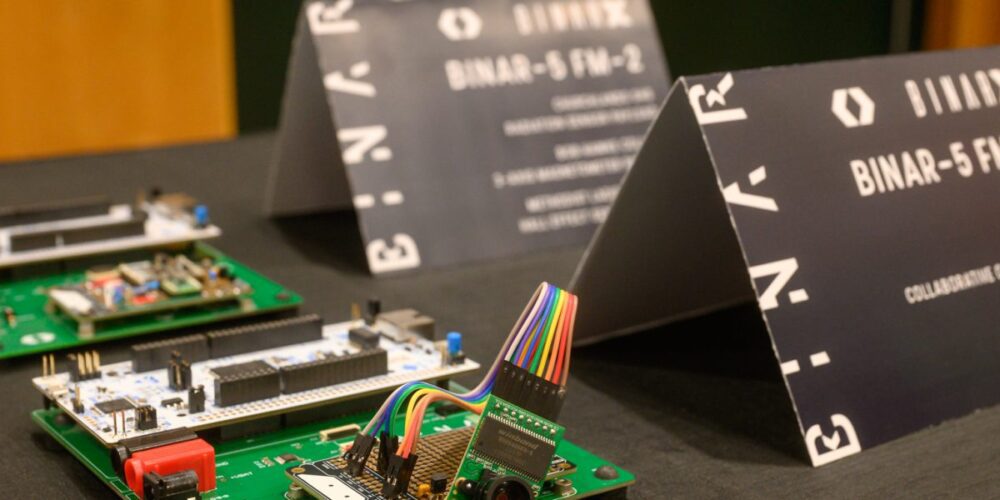
What kind of work do communication satellites involve?
Satellites power GPS navigation, telecommunications, weather forecasting and defence capability. Designing, building and operating these systems requires expertise in electronics, software, physics and systems engineering – skills increasingly in demand across WA’s defence and technology sectors.
At Curtin’s Binar Space Program, engineers are designing, launching and operating WA-built satellites.
“I always loved space and looking at the stars, but until the final year of my degree, I never thought I would be able to work in the space industry in WA. Thanks to Curtin’s ability to adapt and embrace the emergence of a space agency in Australia, I was able to step into what would become the Binar Space Program at its inception. Since starting, I haven’t looked back. I’ve worked in space for my entire career.”
Dr Fergus Downey, Binar Space Program manager
How do planetary scientists study asteroids and the Moon?
Exploring asteroids, the Moon and Mars involve analysing spacecraft data, modelling impact craters and developing new instruments. Curtin researchers are contributing to asteroid tracking, planetary surface modelling and instrumentation for future missions.
At Curtin’s Space Science and Technology Centre (SSTC) – the largest space research centre in the southern hemisphere – Curtin PhD student Michael Frazer is transforming his passion into real-world research.
“My fascination with planetary imaging led me to Curtin, where I now work on telescopic observations of asteroids in our solar system.”
What is remote sensing, and how is it used in WA?
From monitoring bushfires to mapping mineral resources, space-based data feeds directly into WA’s strengths in resources and geoscience. Specialists in geospatial technology and data science interpret satellite imagery to solve real-world challenges.
Curtin researchers are also applying these skills to global projects. For example, the MarONet buoy off Rottnest Island works with NASA’s PACE satellite mission to measure ocean colour, improving climate monitoring and the accuracy of remote sensing worldwide.
How are WA researchers designing and operating space systems?
Spacecraft don’t just launch – they must be designed, tested, operated and continually improved, whether in orbit or here on Earth. Across WA, researchers are building both satellite technologies and advanced ground-based systems that support space science and exploration.
Curtin’s Desert Fireball Network (DFN) and Global Fireball Observatory (GFO) track fireballs with remote camera systems. This helps scientists to determine where meteors come from in the solar system and recover fallen meteorites.
Curtin PhD student Thomas Stevenson has experienced this first-hand while helping establish fireball-tracking networks.
“I started out wanting to become a palaeontologist with a dinosaur obsession. But now I specialise in dinosaur killers – fireballs and the meteorites they occasionally drop. Three of the four fireball cameras that tracked the Takapo meteorite were built and programmed by my own hands!”
From curiosity to career: how do I get a job in space?
If you were the kid who dressed up as a cardboard rocket for science week, stayed up all night stargazing, or spent hours tinkering with gadgets, a career in space might be closer than you think.
At Curtin, our new Space and Planetary Science major gives you the skills and experience to turn that curiosity into a career – from space exploration and asteroid tracking, to remote sensing, Earth observation, and space system design. You’ll build strong foundations in physics, mathematics, computing, and planetary science, then specialise in areas such as planetary geology, astrobiology, satellite observations, and space mission technologies.
Skills beyond space
The knowledge and skills you gain in this course don’t just apply to satellites and planetary science – they’re transferable across industries like defence, resources, data science, and innovation. Hands-on labs and projects let you apply coding, data analysis, AI, and remote sensing techniques to real-world challenges.
According to John Chappell, CEO of Scitech:
“The integration of geology, space exploration, planetary science, and space engineering provides a comprehensive education that is well-suited for the diverse requirements of the space industry. This multidisciplinary focus will not only address critical skills gaps for the sector, but equip graduates with a broad skill set, making them highly versatile and employable”
You can study Space and Planetary Science as part of Curtin’s Bachelor of Science, a flexible degree that lets you tailor your studies toward careers in areas like data science, AI, geospatial technology and software development. Or as part of a double degree with mechatronics engineering. This combination is ideal if you’re passionate about progressive, technology-driven fields such as robotics, automation and Earth observation.
If you’re looking for a tailored, project-based learning experience, you can study this major as part of our Bachelor of Advanced Science. This honours degree course offers you access to world-class research groups and extended student-led projects. This pathway is ideal if you’re considering research, entrepreneurship, or leadership roles in the space sector.
Work-integrated learning, internships, and global collaborations
Internships, research placements and industry collaborations give you the chance to contribute to WA’s growing space sector while you study. You can collaborate with some of the biggest names in space research, including NASA, JAXA and the European Space Agency, and gain experience on projects that have an international impact. NASA recognises Curtin as the formal representative of Australia’s planetary science community, giving you direct exposure to international missions and collaborations.
“In the course of my space career, less than 10 years since graduating, I’ve co-authored 30 scientific publications, travelled to India, Japan, China, and the US as part of my work, met members of royalty and three astronauts!”
Mia Walker, Curtin Space Science and Technology Centre Manager
Ready to launch your space career?
Whether you dream of designing satellites, tracking asteroids, or unlocking the secrets of life in the universe, your journey can start here in WA.
Explore our Space and Planetary Science major or speak with our course advisors to map out your pathway.