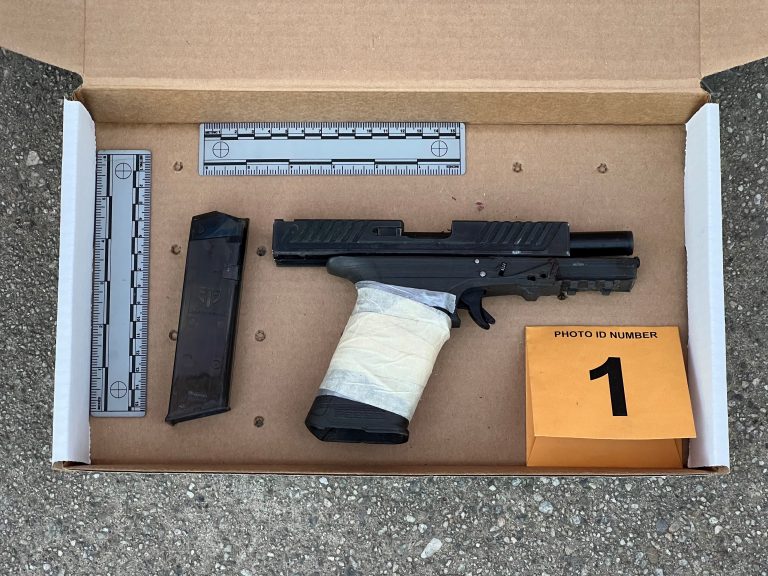
Curtin University researchers may have found a new way to help police trace 3D-printed firearms, after developing a new method of analysing the plastic used to make them.
Homemade plastic weapons present a growing challenge for law enforcement globally, due to being privately manufactured without the serial numbers and registration used to trace conventional firearms.
When discharged, they also often lack the conventional marks left on bullets, limiting another crucial avenue for forensic investigation.
These significant challenges have seen law enforcement commonly refer to 3D-printed firearms as ‘ghost guns’ – however, a new approach to analysis may lead to a significantly greater chance of tracing weapons to their owners.
A new study published in Forensic Science International investigated whether the plastic used in creating these weapons could provide clues capable of connecting a printed firearm to the material used to manufacture it.
Study author Dr Georgina Sauzier from Curtin’s School of Molecular and Life Sciences said the team, including forensic experts at ChemCentre, analysed samples of polylactic acid (PLA), a common 3D-printing plastic sourced from the Australian market.
“We wanted to see whether the plastic used to print the firearm could provide another source of information, by looking closely at how different 3D-printing materials responded when they are heated,” Dr Sauzier said.
“We used a technique known as differential scanning calorimetry, which measures changes in a material as it is heated.”
They found they were able to distinguish 26 of 28 PLA filament samples based on differences in their thermal properties, including some samples that were the same colour but produced by different brands.
Dr Sauzier said 3D printing itself changed how plastic behaves under testing, initially making it difficult to compare a printed object with the original filament used to make it.
“When plastic is fed through a 3D printer it is heated and cooled, which effectively changes its thermal history, so at first the printed material could behave differently to the raw filament it came from,” Dr Sauzier said.
“But we found by giving both materials a controlled heating and cooling treatment, we could account for those differences and correctly match the printed samples with the corresponding filament material.”
ChemCentre senior forensic scientist Dr Kari Pitts said the research will help forensic laboratories assess evidence more confidently in complex cases involving 3D-printed firearms.
“This approach potentially gives forensic investigators another avenue to explore when a 3D-printed firearm and printing materials are seized, or when trying to establish links between firearms recovered in separate investigations,” Dr Pitts said.
However, Dr Sauzier cautioned the research was an important first step rather than a ready-made method for uniquely identifying where every 3D-printed firearm originated.
“This shows there is potentially valuable forensic information hidden in the material itself, but there is more work to do before we understand how reliably it can be applied across the huge range of materials and conditions investigators might encounter,” Dr Sauzier said.
“The next step is to test a much wider range of samples, including printed materials exposed to environments where someone might try to conceal a firearm, such as being buried in soil or submerged in water.
“Ultimately, the aim is to give forensic investigators more tools to extract useful information from weapons specifically designed or manufactured in ways that make conventional tracing difficult.”
The study, Same polymer, different story: DSC analysis of commercial PLA 3D-printing filaments for forensic comparisons, was published in Forensic Science International.