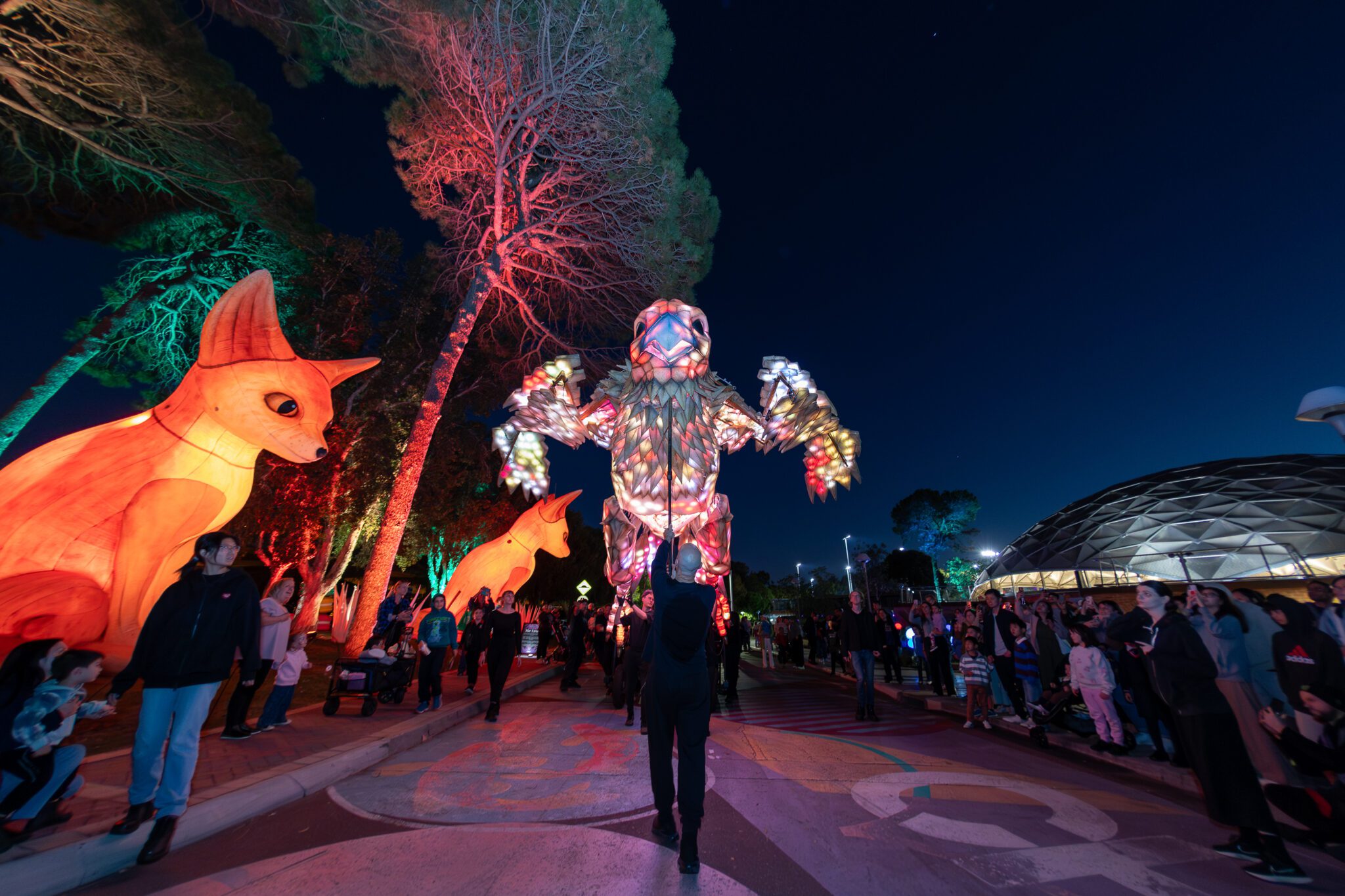
Thousands of visitors flocked to Curtin University over the weekend as the campus transformed into a vibrant, after-dark wildlife wonderland, to help inspire the next wave of conservationists and biological scientists.
Held across two evenings, the free Creatures on Campus drew crowds to explore a spectacular world of illuminated giant animals, cutting-edge animatronics and hands-on science experiences.
From a towering 5m tiger and a falcon with a 10m wingspan to a 27m Kaurna skink and life-like animatronic pandas and giraffes, visitors were immersed in a glowing biosphere where art, technology and conservation came together.
A series of hands-on activities, immersive virtual reality experiences and expert talks by Curtin’s conservation scientists gave a deeper insight into the science behind extinction, fossils and ecosystems.
The occasion was also a chance to show off Curtin’s iconic 1970’s geodesic Dome, which was recently reimagined as an open-air pavilion while preserving its aluminium tessellated panels and bold exoskeleton.
Curtin University Properties, Facilities and Development Director Tim Urquhart said the event showcased the power of bringing research, creativity and community together in an accessible and engaging way.
“Creatures on Campus invited the community to experience wildlife and conservation in a completely new way of blending science, storytelling and spectacle,” he said.
“It was fantastic to see so many people on campus after dark, particularly families and young people engaging with researchers and discovering more about the natural world.”
Across the two nights, visitors also had the opportunity to meet live wildlife, including marsupials, birds of prey, reptiles and amphibians, while hearing directly from leading Curtin researchers working in biodiversity, conservation and evolutionary science.
Curtin Faculty of Science and Engineering Pro Vice-Chancellor Professor Chris Rawson said it was important to bring complex research to life for audiences of all ages.
“Creatures on Campus is part of Curtin’s ongoing commitment to opening its campus to the community and creating opportunities for the public to engage with research in meaningful and memorable ways,” Professor Rawson said.
“We’re aiming to inspire young people who are fascinated by the world around them to follow their curiosity as they grow up.
“Hearing from a world-renowned scientist has the potential to ignite a life-long passion in tomorrow’s conservationists and biologists.”