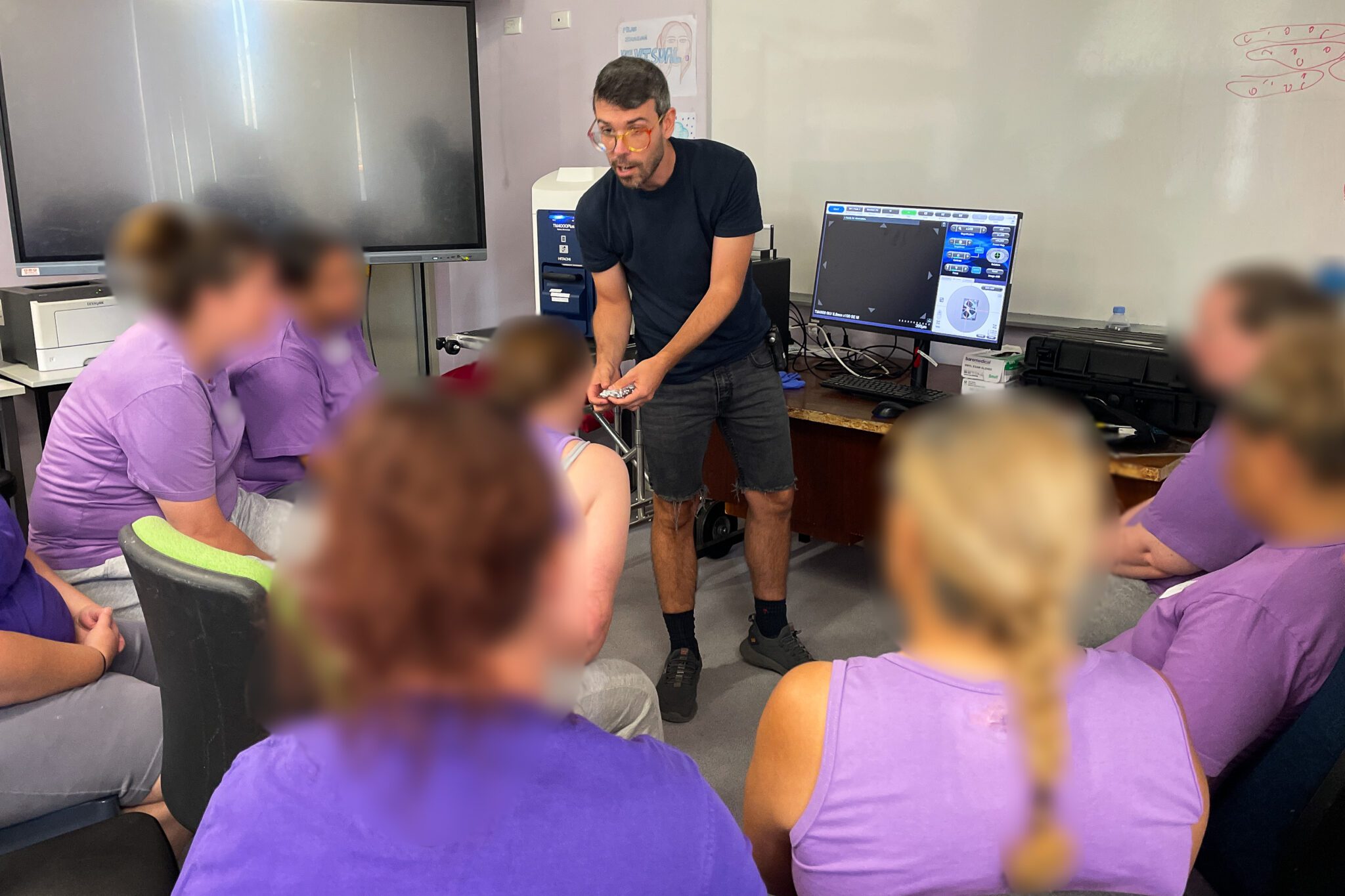
A “super microscope” capable of magnifying the tiniest of objects and usually only found in research labs has been taken inside an Australian prison for the first time, giving people in custody rare access to cutting-edge science.
The Scanning Electron Microscope (SEM) was brought into Bandyup Women’s Prison in Western Australia as part of Curtin University’s Science Meets Art outreach program, which expands access to hands-on learning opportunities in WA prisons to help build curiosity, confidence and practical skills.
Participants used the SEM to examine samples 50 times smaller than the width of a human hair to learn more about the surface composition and topography of everyday objects to help understand how things work.
The Bandyup workshop formed part of Curtin’s Science Summer School, delivered in partnership with the Department of Justice. Science Meets Art sessions were also delivered at Casuarina Prison, while hands-on science outreach activities, including the Science of Cheese, Science of Chocolate and Science of Vitamin C, were delivered at Boronia Pre-release Centre for Women and Karnet Prison Farm.
Curtin’s School of Earth and Planetary Science’s Dr Denis Fougerouse, who co-led the SEM activity at Bandyup with Curtin’s Dr Aaron Cavosie and artist Dr Kirsten Hudson, said the microscope utilised electron beams to magnify tiny objects, revealing the intricate patterns and structures of their miniature world.
“We looked at how insects see the world and can climb walls, trees and leaves, and studied the structure of eggshells to understand how chicks can breathe before hatching,” Dr Fougerouse said.
“After observing these microscopic worlds, the women learned different techniques to translate what they saw into physical artworks, creating postcards they could then send to family and friends.
“It was inspiring to see the women and prison education staff engage so enthusiastically with science.”
Curtin Vice-Chancellor Professor Harlene Hayne said the outreach program was part of a wider University initiative to provide education pathways for prisoners in WA.
“We are proud to provide learning opportunities for people in custody. Education can play a powerful role in changing the trajectory of someone’s life, particularly when they prepare to return to the community,” Professor Hayne said.
Department of Justice Director General Kylie Maj said research consistently showed education was one of the most powerful tools for breaking the cycle of reoffending and supporting long-term desistance from crime.
“Workshops like Curtin University’s Science Meets Art program help equip people in custody with the skills, purpose and self-belief needed to build new futures. By opening pathways to further education and employment, it lays the foundation for stronger outcomes and safer communities beyond prison,” Ms Maj said.
Australian Microbeam Analysis Society President and Curtin staff member Professor William Rickard said he hoped the SEM experience would inspire prisoners to consider future careers in science and technology.
“It is an impressive achievement to bring exciting technology to members of our community who would not otherwise have the opportunity to experience it – something that, to my knowledge, has not been done before,” Professor Rickard said.
The Scanning Electron Microscope used in this activity is the Hitachi TM4000 provided by the Inspire STEM Education Australia program, a national outreach initiative operating in Western Australia with funding from AuScope, Curtin University and NewSpec Pty Ltd.