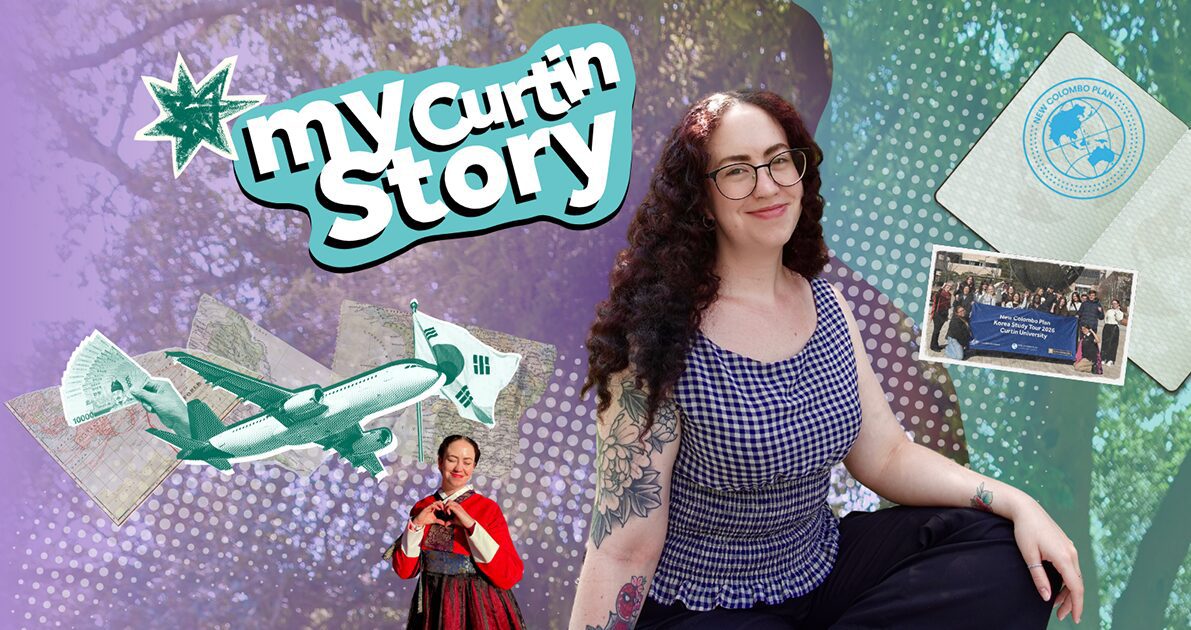
How do you go from being a student in Perth to an intern in South Korea? Meet Temarah, a recent Korean Studies graduate who undertook a New Colombo Plan funded study tour. | Reading time: 4 min.
Temarah’s journey into Korean Studies isn’t one you hear often – she began the fully online while working in corporate full time in New South Wales. With a degree in music already and a love of languages, particularly East Asian linguistic structures, Temarah felt drawn back to the arts field. After dipping her toe into the Korean Studies course through taking a few units with Open Universities Australia, she knew it was time to pursue the full degree.
“After two years completely online while working full time, I really wanted to be on campus for my final year. So, I made a split-second decision, much to my family’s dismay, and packed up and moved to Perth in two weeks.”
In her final year, Temarah undertook an internship in South Korea through a New Colombo Plan funded five-week study tour. After touring key sites and attending workshops with her peers and academics from Curtin’s Korean Research and Engagement Centre, Temarah began her internship with the Australian Chamber of Commerce. She notes the internship had a very interesting working dynamic, as most of her colleagues were either Australian, Korean-Australian or Koreans with strong links to Australia.
“It operated like a Korean workplace in the sense that everyone’s very close-knit. However, it was also casual in an Australian sense, which is sometimes a bit uncharacteristic of a Korean business, and that was really nice. Their personnel is so tiny, but their outreach is so large, so the number of business connections that I made at that time is wild.”
One of her highlights from her time in Korea was touring the Samsung shipyards in Geoje, especially since Temarah herself comes from a naval military background. It helped her grasp the true scale of Australian-Korean relations and import-export industries.
“To see some of these huge ships that were getting built as we went through the shipyard was incredibly impressive. It made the industry connections between Australia-Korea seem very real and tangible.”
Temarah also notes Mix at Six, the large business mixer she worked on during her internship, as another highlight. Being put on the front door felt like a ‘sink or swim’ situation, but this test of her language skills and business etiquette led to professional connections who now ask when she’s returning to Korea.
“There’s a large space for Australians in Korea to build connections and thrive over there, which was an eye opener to me. It was really cool to see how many Aussies are over here doing really well in the business and diplomatic spaces.”
Temarah didn’t feel a major culture shock in South Korea, as she had visited before and felt her studies and language skills prepared her for the internship and new environment. The only shock were the winter temperatures in Korea, which were more challenging than anticipated.
“Perth gets cold in winter, but not negative 13 – we’re not snow and ice territory like South Korea. On the first day we got there, trying to walk up the hill to our accommodation, I absolutely face-planted in the snow!”
Even though Temarah came to South Korea with some fluency, her biggest learning curve was building more confidence in speaking. Going into the experience, she was worried – but being exposed to situations like mixed language meetings allowed her to absorb more and realise her grammar didn’t need to be perfect to hold a conversation.
“I remember one day, I was really tired and went to a convenience store to grab a coffee and ended up talking to the lady working there. When I left, I realised I’d just had a whole conversation in Korean, which was really cool! It helped me realise that I was much more capable than I assumed I was.”
For Korean Studies students considering going to South Korea, Temarah says with 100% certainty to go on the trip. And while the course does prepare you with cultural fluidity training, she advises doing some research beyond what you might learn in class, especially around business structures.
“Business and social hierarchies are very important in Korean society and are touched on a lot in general research. But it’s one of those things that Korean Studies students can really utilise to their advantage in an internship environment, such as paying due respect to your superiors. It really does make you look a lot more professional.”
After taking a break following her upcoming graduation, Temarah intends to pursue an honours degree and continue her studies in Korean language and culture.