For Elena, a degree that began in animation and game design has become a pathway into one of the fastest-evolving areas of the creative sector: virtual production.
Through Curtin’s new Digital Creative Industries program, Elena Epis has gained hands-on experience with emerging screen technologies and developed the confidence to explore opportunities in Australia and overseas.
“What we’re learning at Curtin matches the industry trends,” Elena said. “I’m using everything I learned in the games and animation areas of my course but I’m able to translate it to video and film production.”
A better course for changing creative technologies
The Bachelor of Digital Creative Industries prepares students for a fast-moving creative landscape shaped by emerging technologies and industry practices.
Senior lecturer Jonathan Pillai said the course expands Curtin’s former animation, games and digital user experience program into a broader creative ecosystem.
“We’ve taken a successful program and extended it to reflect the way creative technologies are converging,” he said.
“The degree now has majors in animation, visual effects and virtual production (VP); game art and design; and immersive UX, with another major planned for the future.”
That transition has opened up access to virtual production technologies, which, Jonathan explained, “is a clear example of where film and games are coming together”.
An advanced studio for student productions
For Elena, the new course arrived at the right time. “I started my course when it was Animation and Game Design, but I was lucky enough to pivot to virtual production for my final unit, and actually design a project using Curtin’s new LED soundstage.”
“Even large film studios are experimenting with LED virtual production. Like the TV series The Mandalorian. They filmed in an LED soundstage, using real-time renders for the background of some of their environments,” she said. “It’s really changing the way that film is made, so it’s great to be learning it at uni.”
Jonathan paid tribute to Curtin’s initiative in bringing virtual production into the student learning experience.
“Curtin actually began exploring virtual production during COVID, with a small experimental LED stage. From there, we started looking for a partner who could help us bring industry best practice into the curriculum and studio pipeline,” he said.
So, what exactly is an ‘LED stage’?
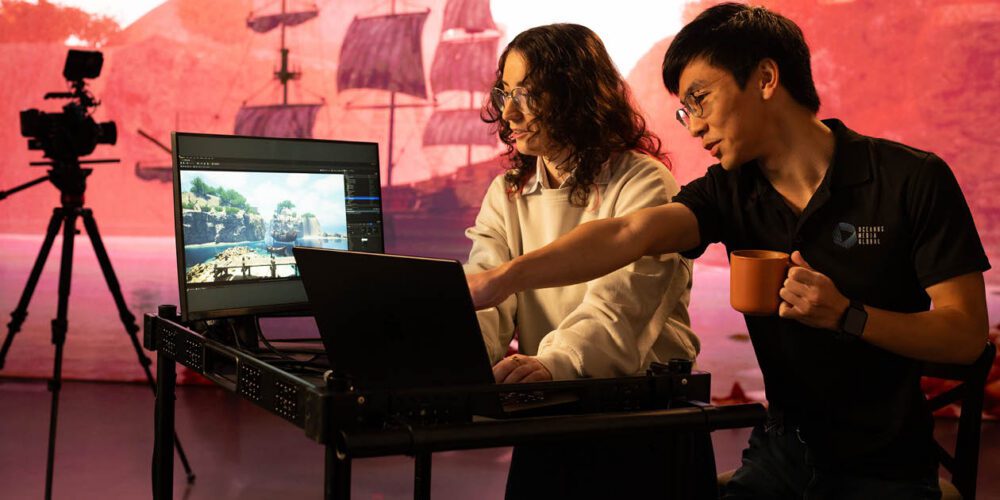
“There’s a real camera used for filming on set, which is directly tracked to a digital camera inside a rendering software. This is directly capturing the virtual environment built in the software,” Elena explained. “The two cameras link up, so when the real camera is moved, the environment moves with it on the screens.
“We’re creating a digital scene that responds to the movement of a physical camera. Most projects are aiming for realism. So, you need realistic objects to fill an environment, with realistic lighting – which requires us to think like filmmakers as well as digital artists.”
Industry partnerships with global reach
Elena’s initial work experience came through Curtin’s AGDX Studio, where students work on real-world, industry collaborations.
“Our team helped produce animated videos or games for external clients through Curtin,” she said. “In one project, we created a motion-graphic video for a client who used to play in the AFL. It’s a great way to apply your skills as a student and start building industry connections.”
A major turning point came through Curtin’s partnership with Oceanus Media Global, which helped shape the virtual production stage and build best-practice industry pipelines into the course.
That partnership came after about a year of conversations,” Jonathan explained. “Oceanus Media Global brought expertise from its Singapore studio and its large LED volume in Iskandar Malaysia Studios – and that’s been invaluable for showing our students how these workflows operate internationally.”
Through that partnership, Elena was one of four students selected for a six-month placement with Oceanus Media Global in Singapore.
“I used my game design skills in a software called Unreal Engine to build 3D virtual environments,” Elena said. “The internship was my first jump into VP, and I was lucky enough to learn it in a different country.”
Supported by a New Colombo scholarship, the internship gave Elena a chance to apply her creative skills in an international setting.
“I got to go somewhere new, learn about a new culture, meet different people. It’s definitely been the most memorable part of my degree.”
Stepping into a career with confidence
For students entering a rapidly changing creative sector, confidence matters as much as ability. Elena said the internship helped her feel ready for the next stage of her career.
“Being able to say that I’ve created work that has been used in commercial projects is a massive confidence boost. It really does make you feel ready for the industry,” she said.
“I definitely can see myself working in the industry, and I feel confident enough to approach a VP company and give them my résumé.”
Along with technical expertise and industry experience, Elena’s course has helped her build a close creative community.
“It’s great to work with lecturers like Jonathan who’ve worked on real industry projects, along with other students with similar interests. There’s definitely students that I’d collaborate with on making a game or a short film,” she said.
“Elena’s pathway shows how we want Curtin’s creative ecosystem to work,” Jonathan said. “Students build confidence through studio-based projects, then connect with industry partners locally and internationally.”
Curtin is also growing its network of industry partners across Perth, giving students more opportunities to connect with professionals, build real-world skills and explore future career pathways.
Elena has already benefited from these connections, with Sandbox Productions, the team behind the Curtin Universe videos, offering to collaborate with her for her university work.
Making the most of creative opportunities
Elena’s uni experience shows exactly how creative study can open up practical, industry-facing opportunities. So, what would be her advice for anyone considering choosing Digital Creative Industries?
“Absolutely give it a go!” she said. “You’ll learn so much about the industry and be able to build connections.”
She said students should make the most of Curtin’s opportunities, because passion matters as much as talent.
“People will definitely notice that you’re really committed and hardworking,” Elena said. “At the end of the day, that’s what they’re looking for, and it can take you pretty far.”
Learn more about how Curtin can help you graduate career-ready with skills that take you beyond the classroom. And if you’re keen on a creative career in a dynamic industry, explore our Bachelor of Digital Creative Industries.