Reading time: 5 minutes
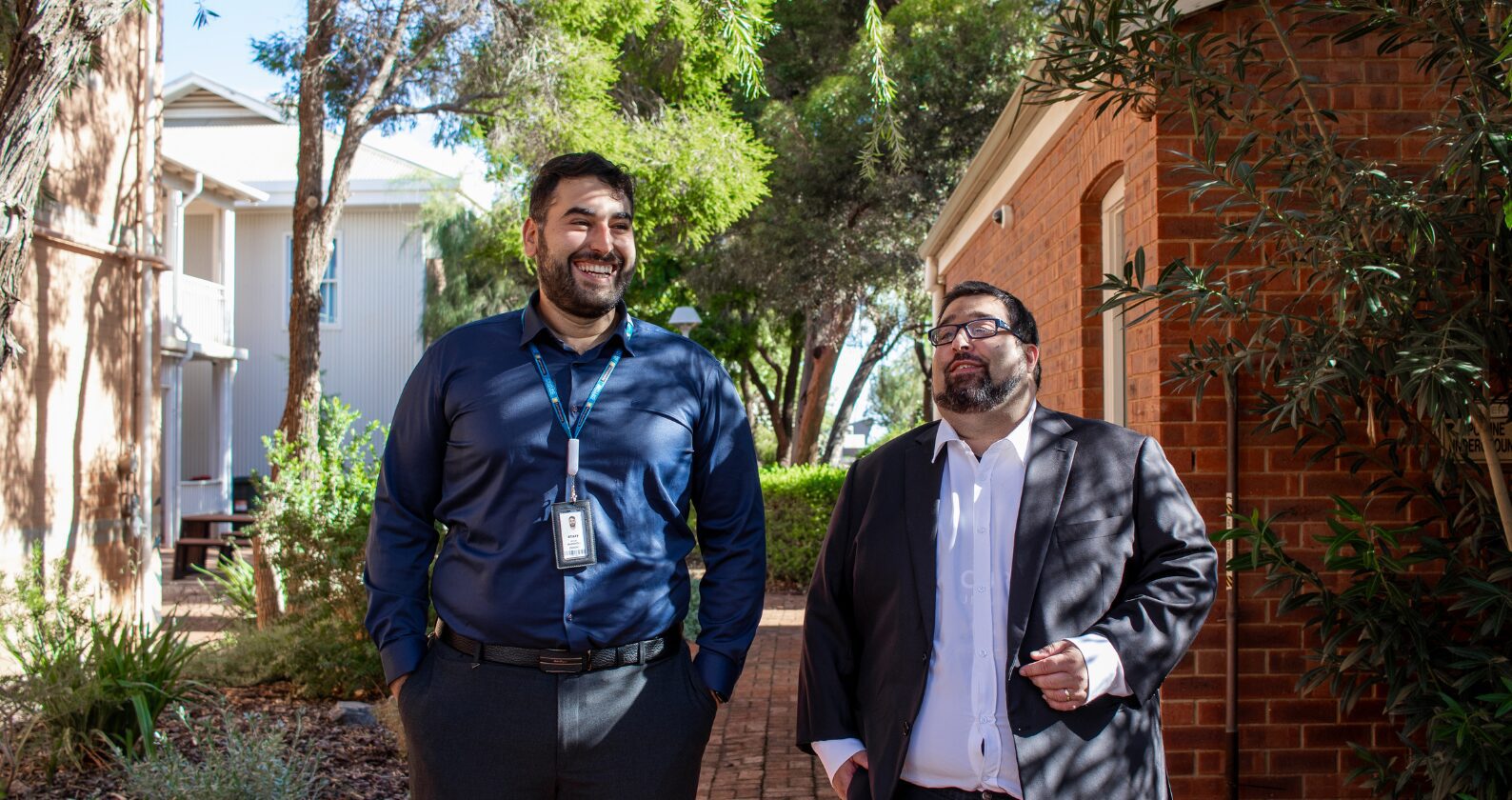
Anvar Mammadli and Dr. George Barakos reflect on Anvar’s PhD journey thus far.
George:
I thrive from teaching and mentoring students like Anvar. It’s not a professor-student relationship; it’s a collaboration. I also find it is equally important to shape the next generation of researchers and potential academics.
My supervisory style is tough sometimes, but I’m always fair. The way I’ve also been supervised and taught is a structured way that includes how to conduct research and gradually taking the student by the hand, and as they progress, leaving them to take the steps by themselves. For example, Anvar is helping me under my auspices, co-supervising undergraduate and master’s students for their theses.
I want my students to learn all these things so that they’re not just doing research on a specific field, but they are also learning how to become researchers, how to become future academics.
Anvar stood out to me for his passion and motivation to learn. He had some basic knowledge, but he was eager to learn much, much more. And he has shown that consistency in his passion to learn.
The biggest challenge has been the research. Anvar really dug into the literature; he went back to 1914. So the amount of data and the noise on this data was such that we gathered them, but we couldn’t know how to start analysing them. Eventually, we found the way. We broke down into as small factors as possible, and then we again merged, took the essence out of them, merged similar ones, and we came up with the classification that is going to become a publication very soon. Hopefully, we’ll have a very impactful paper in the top journal of our field.
The greatest achievement was the tool that Anvar created. Anvar is an Excel and AHP expert, and now a fuzzy logic expert to the extent that I would say he knows much more than I do. For me, my greatest achievement is that he can now realise that he has surpassed me in knowledge of these things.
He’s also the sole investigator in the world who has developed such a tool. This is the very first time that someone has broken down the criticality analysis into the different parts, like exploration, mining, processing, and that will help a lot for policy makers, decision makers, companies, and governments to understand where the real bottlenecks are in the supply chain.
Having me as a supervisor was a risk for him because I have co-supervised PhD students in the past, but he was the first one that I was the primary supervisor. I took a risk because Anvar has that passion, that motivation.
My advice, as I always say to Anvar, is to look back five years, where you were five years ago, and what your knowledge and skills were, and where you are now, and then try to think where you would be five years from now. Keep on progressing, keep on improving.
Anvar:
Previously, I studied mining engineering in Azerbaijan. I focused more on technical issues, like operations and other mining-related stuff. Later, I went to Germany, and I did my master’s degree in sustainable mining and remediation management, where I realised that mining is not only a technical issue, but a broad concept, with geopolitical, economic, environmental, and social factors as well. Therefore, I chose to pursue a PhD in critical minerals.
My PhD project focuses on developing a smart decision-making analysis tool to assess the criticality and strategic importance of minerals. But unlike traditional criticality assessments, which release static lists, this methodology introduces a stage-based framework that is going to assess minerals through the value chain, including exploration, mining, processing and manufacturing.
My research topic sits at the intersection of mining, global supply and demand, and energy transition. Lithium, cobalt, nickel, and other elements are essential to technologies like batteries, advanced manufacturing, and renewable energy systems. But as global demand increases, countries cannot fully address the complexity of the supply chain. So one of the aims is to address all unclear parts; we incorporated 49 impact factors that can fully address all these issues.
My end goal is that the developed tool, the decision-making tool, is going to be helpful for governments, industries, and academia, who are trying to understand the criticality.
This work is very holistic, and it will actually be helpful for those who are planning to invest in mineral commodities, showing where the gaps and opportunities are, and will be helpful for the decision-making for governments.
George, my supervisor, moved to Australia and he offered the position; I am actually his first PhD student in Australia. George was my lecturer first in Germany–he was teaching us radioactive minerals. I became very familiar with his research projects and his guidelines. So then he offered this position in Australia, and I was very happy to accept it.
The most important lesson I’ve learned almost since the first day of my PhD was something that George said:
A PhD is a marathon, and there are always ups and downs, so focus on your final goal, but at the same time, you have to enjoy every moment of this journey.
I had been feeling that I was not capable of doing this research. But every time George motivated me, like “I know you, you can do it.” He took a risk because I knew that I didn’t have that knowledge, and I was always questioning myself or wondering how I was going to do. But because of George’s motivation, I achieved this. Before the conferences, I was very nervous, and I didn’t know how I was going to address the issues or how I was going to talk, but he was motivating and inspiring me. The very good moment after the conference, when he told me, “I’m proud of you”, was the biggest reward I wanted to hear only from him.