There are few places on earth as powerful and endlessly captivating as the ocean, yet Curtin Marine Science (Honours) graduate and PhD candidate, Brodee Lowe believes much of it remains largely a mystery.
With close to a decade of experience in the industry, Brodee’s dedication to uncover the enigma of life below the waves led to an extraordinary opportunity.
World leading historian, Sir David Attenborough’s film crew reaching out to Brodee’s team, led by Grace Russell, to film his most recent documentary, Ocean.
Brodee’s specialised diving skills and wealth of experience working with blue whales led to her becoming a safety diver for part of the film.

Swimming eye to eye with the beautiful animal she’s dedicated her research career to protecting for this once-in-a-lifetime opportunity, completely blew her mind.
“All I had was this little DJI Osmo camera, it was never going to fit the whole 25-metre-long animal in the shot (laughs),” she said.
“I was so overwhelmed I ended up waving at the whale – you can see my hand in the film.
“It was definitely a pinch me moment, I’ve never felt so small yet so connected to the natural world, it was just insane.”

This moment served as a powerful reminder of how deeply connected we are, as humans, to the ocean, and the importance of protecting these fragile yet vital ecosystems.
As our oceans continue to bear the brunt of climate change, paving the way forward for the next generation of aspiring marine scientists has become even more important.
Brodee still remembers the day she fell in love with marine science.
She was eleven years old when a visit to a pearl farm in Broome on the Kimberley coast in Western Australia opened a whole new world of possibility.

“I didn’t know what marine science was until I went to a pearl farm in Broome,” she said.
“I was helping dissect a pearl out of a clam and it just blew my mind that there was jewellery inside of this living thing.”
That evening her dad explained that studying the ocean and its creatures is a profession. From there, Brodee knew she wanted to be a marine scientist.
But when she approached the end of her undergraduate degree, she yearned for more.
It wasn’t long before she began her Honours in Marine Science at Curtin.
As part of her Honours program, Brodee completed fieldwork onboard a whale watching vessel in WA’s Southwest region, collecting photo-identification imagery of whales to assess their population.
Not long after her degree she began working on the same whale watching vessel as their onboard marine biologist. This is when she witnessed her first pygmy blue whale, and the rest is history.

“I still remember the blue whale coming up from the depths of the crystal-clear water, almost glowing – we call it Gatorade blue,” she said.
“Seeing their exhale blow more than ten metres into the air is an experience, and I couldn’t believe I was being paid to witness this moment, it’s such a dream come true.”
This moment set her on a path toward a post doctorate in the socioeconomic value and acoustic ecology of pygmy blue whales, helping to inform conservation efforts for the endangered species.
But these incredible career opportunities have not come without hard work and perseverance.

Having spent the last decade working in marine science, Brodee has experienced first-hand how challenging it is for early career scientists to break into the industry.
“At the start of my career, I did a lot of volunteering, internships and unpaid work which was overwhelming at times and there were moments where I felt like I wasn’t getting anywhere.”
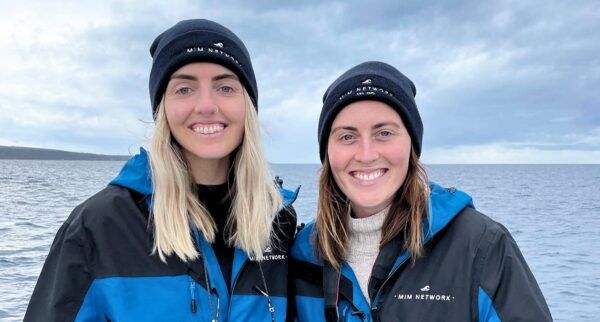
On a mission to change this, Brodee and her friend, Emily created the Marine Industry Mentoring (MIM) Network to give aspiring marine scientists the network they wish they had when they started their careers.

Through the power of community, Brodee and Emily have created a space that empowers the next generation of marine professionals through mentorship, hands-on experience and purpose-driven pathways that connect science, industry and community.
“When you leave university, the real world can be overwhelming, so the network is about creating a better community around work that is less about hustle and more about intention,” she said.

When it comes to pursuing a career in marine science, Brodee’s advice is to say yes before you’re ready.
“Show up, ask questions and don’t underestimate the value of genuine relationships and showing up as the best version of yourself,” she said.
“Marine science is a big world – it’s only until you start working in the industry that you realise how small it actually is, but at the same time it can be really generous to you, as long as your generous to it.”
Brodee Lowe, Senior Marine Scientist & Co-Founder and Director at MIM Network and MFOS Australasia
Graduating from Curtin with a Master of Science (Honours), Brodee is passionate about protecting our marine environment for future generations. With ten years’ experience in the marine industry, Brodee has worked on various marine projects across industry, government, academia and conservation sectors. Currently, she is a PhD Researcher at Curtin’s Centre for Marine Science and Technology (CMST) where she is exploring the socioeconomic value and acoustic ecology of pygmy blue whales in Australian waters.