Three new Aboriginal doctors are helping create healthier futures for their communities
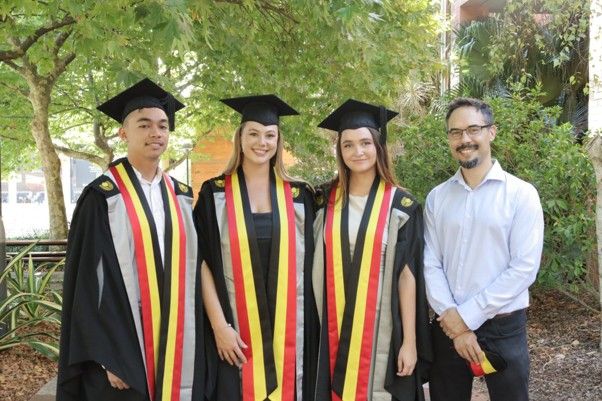
(L-R Curtin Medical School graduates Jaaron Davis, Arkayla McPhee and Daisy Alps with Curtin Deputy VC, Indigenous Jonathan Bullen)
For Dr Jaaron Davis, becoming a doctor is about far more than a medical degree. It’s about family, culture and creating change.
Raised in the Kimberley and now preparing to begin his career in Broome, Dr Davis is one of three Aboriginal graduates from Curtin Medical School who recently crossed the stage together, united by a commitment to improve health outcomes for Aboriginal and Torres Strait Islander communities.
Alongside Dr Daisy Alps and Dr Arkayla McPhee, he represents a growing generation of Aboriginal doctors helping to inspire a more culturally informed healthcare system.
“For my family, this is not an individual success but a collective one, grounded in culture and community,” Dr Davis said. “It represents the realisation of dreams carried across generations.”
For all three graduates, medicine was never simply a career choice.
Dr Davis said growing up between the Kimberley and Perth inspired him to pursue a path where he could make a difference.
“I wanted to become a doctor because my life has been shaped by walking between different worlds and witnessing the stark inequities that exist between them,” he said.
“Growing up in the Kimberley, and later navigating life in the city, taught me that the people and places around you shape who you become. That realisation transformed my motivation into purpose.
Dr Davis will begin his medical career in Broome.
“I’m so grateful to be able to make a big difference with my community. If you’re surrounded by goals and ambition, and an environment that creates positivity and an environment that builds foundation into working hard, you can achieve it,” he said.
Yamatji and Njamal woman Dr Arkayla McPhee knew she wanted to become a doctor after working as a medical receptionist not long after finishing high school. Now, as a graduating doctor, she plans to become a rural generalist and eventually return to regional and remote communities.
“Throughout my studies, I developed a clear sense of purpose to become a clinician who delivers culturally safe, compassionate, and equitable care. I want to support my Aboriginal and Torres Strait Islander patients during vulnerable and challenging times and create positive healthcare experiences,” she said.
“My plan is to gain a wide range of clinical skills and experiences in the city to build my clinical confidence, before returning to work in rural and remote settings. I’m particularly interested to pursue additional training in areas such as critical care and Aboriginal health.
“It means the world to me to be able to go back into the real world as a medical professional and make a positive change towards the people in my community and the Aboriginal community.
“As an Aboriginal doctor, I want to be part of meaningful change and contribute to Closing the Gap for our communities.”
Curtin Medical School welcomed its first students in 2017 with a strong emphasis on preparing graduates for careers in rural, remote and outer metropolitan communities where there is a shortage of doctors.
The success of Dr Davis, Dr Alps and Dr McPhee reflects the growing impact of Aboriginal leadership in healthcare and the importance of creating pathways that enable future generations to follow.
As they begin their careers, each carry with them the hopes of their communities and a shared determination to make tomorrow better.
To find out more about studying medicine at Curtin, visit curtin.edu/studymedicine.