Course overview
Due to rapid technological advances, medical imaging and radiation therapy sectors are continuing to expand.
In this course, you will gain the expertise in medical radiation science to diagnose, treat and monitor medical conditions or provide cancer therapy.
If you’re fascinated by how medical technology helps diagnose and treat health conditions, this course will give you the knowledge and skills to make a difference in patient care.
Career outcomes
Due to rapid technological advances, medical imaging and radiation therapy sectors are continuing to expand. In Australia, professional roles in medical imaging are expected to grow by 33% by 2035.¹
Careers
- Medical imaging professional
- Radiation therapist
Industries
- Clinical research
- Health and safety
- Private medical practice
- Hospitals
- Technology supply
- Support services
- Tertiary education
¹ Source: Jobs and Skills Australia – Employment Projections.
Professional accreditation and recognition
This course is accredited by the Medical Radiation Practice Board of Australia.
Why study at Curtin?
Cutting-edge
Major in either Medical Imaging or Radiation Therapy – two areas of rapid technological advancement.
Work experience
You’ll undertake 45 weeks of clinical experience in hospitals, private practices, and rural and regional health sites.
Professional recognition
This course is accredited by the Medical Radiation Practice Board of Australia.
Hear from our students
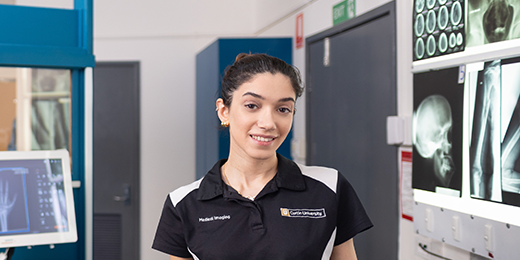
"I chose Medical Radiation Science because I like hospital environments and patient care. Curtin was my top choice because it focuses on the practical aspect of your studies, regardless of your course, which is extremely useful for entering the workforce. I enjoy my clinical placements the most as I get to put my theoretical knowledge into practice. Teamwork and collaboration are also important skills that I’ve gained."
Soha Bastani
Bachelor of Science (Medical Radiation Science)
Your student experience

Work-integrated learning at Curtin: explore a Universe of opportunity
Develop real-world experience before you graduate. Learn how work-integrated learning helps you build career skills and connect with industry early.

Thinking about uni? Five reasons Curtin could be your best move
Not sure if uni is for you? Explore five clear reasons students choose Curtin – from flexible pathways and support to real-world skills and outcomes.

Find your entry pathway to Curtin
You may be finishing high school, coming from TAFE, or just thinking of a career change; but whatever your background, there’s an entry pathway to Curtin for you.
Course structure
What you’ll learn
To begin with, you'll study interprofessional health units with students from other disciplines. You'll then focus on discipline topics – including medical physics, anatomy, pathology, physiology and evidence-based practice – along with subjects that prepare you for healthcare environments.
You’ll also develop medico-legal, ethical and cultural awareness, and the communication skills needed for the responsible care of patients.
During your course, you’ll undertake 45 weeks of clinical experience in hospitals, private practices and rural and regional health sites.
This can be a physically and mentally challenging course. Please read the inherent requirements before applying.
Detailed course structure and unit information
For detailed information and course structure, visit our Handbook.
Customise your degree
Customise your degree by choosing to major in either Medical Imaging or Radiation Therapy.
Medical Imaging
Medical imaging professionals work with sophisticated diagnostic imaging modalities – including digital radiography, fluoroscopy, computed tomography, magnetic resonance imaging, mammography and angiography equipment.
They produce images that are used to inform medical diagnoses, advise on treatments or illnesses, monitor patient progress or provide medical screenings.
Radiation Therapy
Radiation therapists have an integral role in the treatment, care and management of patients undergoing radiation therapy treatment, primarily in treating cancer types.
They use a range of complex technologies and equipment to design, develop and deliver radiation therapy treatment.
Entry requirements
To study this course, you must meet the entry criteria:
- any course-specific requirements
- course ATAR, or equivalent, demonstrated via an accepted entry pathway
- English language requirement.
I am an international student
Studying on an Australian student visa? See entry requirement details for international students.
Minimum ATAR entry required
This course requires you to achieve a minimum ATAR/selection rank to be considered for entry, but does not guarantee selection.
Course-specific requirements
You’ll also need to meet any specific requirements to be eligible to apply for this course.
Entry pathways
There are different ways to meet our academic entry requirements. Choose the option that best suits the highest level of education that you’ve achieved.
Curious how students entered this course? See the entry pathways other students have taken.
Study credit and support
You may be able to receive study credit or support based on your previous experience or personal circumstances.
Get credit towards your degree
You may be able to receive credit for recognised learning (CRL) from past study or professional experience, which could reduce the time it takes to finish your course.
Find specific details about CRL for this course on the Handbook.
Special consideration
If your studies were affected by circumstances beyond your control, you may be eligible for special consideration when applying to Curtin. This process is available to new applicants only and allows your application to be assessed in light of those circumstances.
Additional information
Notes about this course
Make sure you check the course notes for any other important information.
Ranking selection process
Please note that entry into this course is highly competitive and subject to available places. If you are not made an offer in an earlier round, your application will remain under consideration for subsequent round in January, dependent on place availability at that time.
- Round 1: 10 December 2026
- Round 2: 14 January 2027
School leaver applicants to refer to TISC – important dates
A limited number of at-school offers may be available to School leaver applicants with outstanding results.
Please note:
- Applicants will be ranked and selected based on published entry requirements and entire academic record.
- Applicants must provide all required documents and be assessed as eligible to be included in the ranking for an offer.
- Meeting the minimum entry requirements and course specific prerequisites, does not guarantee selection.
- Applicants with outstanding results will only be considered for an offer upon submission of the results.
- Eligible applicants will remain in the ranking pool until the conclusion of all offer rounds.
- The University reserves the right to close applications and not proceed with subsequent offer rounds once course capacity is reached.
Fees
2026 Domestic indicative fees
Commonwealth-supported first-year fee
$9,600*
Important information about fees
- *Fees are indicative only
- First year fees are based on a first-year full-time study load of 200 credit points. Your fees will vary depending on the units you choose.
- This indicative fee does not include other fees like administrative and incidental fees (such as lab coats or art supplies) or the cost of your textbooks. Visit other fees and charges for more information.
Scholarships
Get the support you need to succeed with our diverse range of scholarships. Whether it’s financial support, assistance with relocation, or recognition for your academic achievements, we have scholarships tailored to your unique needs.
How to apply
Follow these steps to make sure you’re eligible, prepared and ready to apply for your course.
Check entry requirements
Entry requirements differ by course and your previous work and study experience.
Prepare your documents
The documents you need may vary depending on your course and application pathway.
Check application deadlines
Deadlines vary by course and whether you’re applying as a domestic or international student.
Choose your application pathway
I’m in year 12 or applying for Medicine
If you’re in year 12 or recently finished high school, you’ll need to apply through TISC.
You’ll apply through TISC no matter what you studied in high school, whether that was:
- ATAR
- General subjects
- Certificate IV
- or completing UniReady in Schools program.
TISC has different application dates to Curtin. Visit the TISC website for all important dates, including application deadlines.
I have finished high school
If you’re not a current year 12 student or recent graduate, you’re considered a non school leaver and you’ll apply directly to Curtin.
The only exception is Medicine, which must be applied for through TISC.
You’ll apply directly to Curtin if you are:
- a high school graduate who finished school last year or earlier
- transferring from another university
- returning to study or using your professional experience to qualify
- progressing from a VET or TAFE qualification or bridging program
- a current Curtin student changing courses or campuses.
Application deadlines can vary by course. Make sure to check application deadlines before you apply.
ApplyLocation and delivery
Thinking about starting soon? Course availability can vary by location and study period. Check the course handbook for details on when and where you can start your studies.

For full entry requirements, fees and information for international students, visit the course page.
Explore more
Find more resources to help you take the next step in your Curtin journey.