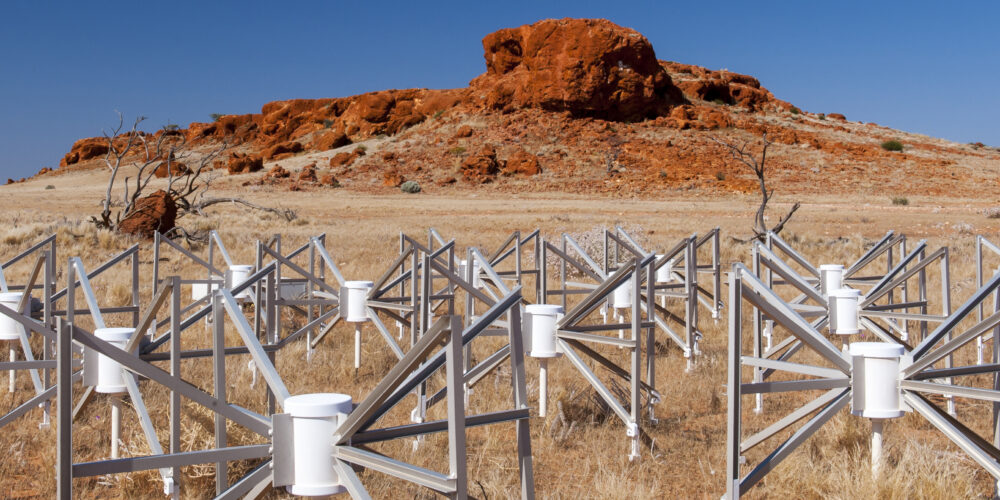
Low-frequency radio astronomy, typically operating in VHF/UHF frequency bands, relies on large-scale aperture array systems to probe some of the most fundamental questions in cosmology, including the formation of the first luminous structures and the evolution of the early Universe through the redshifted 21-cm hydrogen line. Unlike traditional dish-based telescopes, modern low-frequency instruments employ aperture antenna arrays, where signals are combined coherently across large numbers of distributed antenna elements to form electronically steerable beams with wide fields of view. The Square Kilometre Array (SKA), particularly its low-frequency component (SKA-Low), represents the most ambitious realisation of the aperture array technology. It will consist of ~130,000 antennas arranged in a spiral configuration, enabling its unprecedented sensitivity. Strong electromagnetic interactions between antennas, called mutual coupling, especially prominent in the dense core might limit its performance. As observational requirements aim at detecting extremely faint cosmological signals, such as those associated with the epoch of reionisation, these coupling effects become a limiting systematic. SKA-Low has been developed through a series of pathfinder and precursor instruments, including the Murchison Widefield Array (MWA), Low-Frequency Array (LOFAR) and the Long Wavelength Array (LWA). These instruments have demonstrated the scientific potential of low-frequency aperture arrays while simultaneously revealing the increasing importance of precise electromagnetic modelling for calibration fidelity. This project addresses this challenge through a framework that quantifies mutual coupling in aperture array interferometers. It integrates full-wave electromagnetic simulations, semi-analytic models and visibility-domain analysis to connect our understanding of antenna electromagnetic interactions directly to observable data products. By bridging electromagnetic modelling and interferometric measurements, the project aims to establish a validated, scalable methodology for characterizing and mitigating mutual coupling effects in next-generation low-frequency radio astronomy telescopes.
Aim
The aim of this project is to quantify mutual coupling between aperture arrays and propose its mitigation. It is expected that the candidate will evaluate novel semi-analytic mutual coupling models by benchmarking them against full-wave electromagnetic simulations, visibility simulations and observational data.
Objectives
- Electromagnetic modelling of mutual coupling in low-frequency aperture arrays
- Development of analytic and/or semi-analytic models and their validation against full-wave electromagnetic simulations
- Visibility-domain propagation of mutual coupling effects in simulated observation pipelines and comparison with existing measured data products
- Impact assessment on calibration fidelity and cosmological signal recovery
Significance
This research strengthens the engineering foundation of next-generation low-frequency radio astronomy by addressing a critical limitation in current modelling frameworks: the incomplete characterisation of mutual coupling at the array-to-array level. Electromagnetic simulation of aperture array antennas have established that physically grounded modelling is essential for understanding beam non-idealities and calibration systematics.
This project advances that trajectory of epoch of reionisation science by explicitly focusing on mutual coupling as a measurable, predictable and correctable error source that links antenna physics to astronomical observables. By combining full-wave electromagnetic modelling with scalable analytic formulations, the project directly addresses a key challenge in current low-frequency radio astronomy arrays. The resulting validated modelling framework will provide a pathway for incorporating mutual coupling effects into calibration strategies without prohibitive computational cost. The integration of simulation and real visibility data ensures that the outcomes are not purely theoretical but are directly grounded in operational radio astronomy instruments. This project requires solid understanding of the link between antenna engineering and radio astronomy data processing. It will enable improved calibration accuracy, reduced systematic bias and reliable detection of faint cosmological signals from the early Universe.
Ideal Candidate
We are seeking a highly motivated PhD candidate with strong analytical, problem-solving and communication skills. Applicants should have a background in electrical and electronic engineering, astrophysics, computer engineering, radio astronomy engineering or a related discipline. Experience in antenna engineering, electromagnetics, signal processing and radio astronomy is desirable. Familiarity with programming (e.g., MATLAB or Python) is required. Additionally, the applicants should meet the eligibility criteria for entry into a PhD program at Curtin University.
This project is open to Domestic applicants only.
Scholarship
If you are identified as the preferred candidate for this project, you may be considered for an RTP scholarship.
Enquires and How to Apply
For enquires about this opportunity contact Dr Maria Kovaleva at Maria.Kovaleva@curtin.edu.au
To formally apply submit an Expression of Interest to Dr Maria Kovaleva during the Central Scholarship round (July 1st – July 31st 2026)