Ichthyosaurs were a highly successful clade of marine reptiles that inhabited the world’s oceans from the Early Triassic through to the mid-Cretaceous. Throughout this extensive evolutionary history, ichthyosaurs underwent significant morphological and ecological changes, particularly between the Jurassic and Cretaceous periods. Jurassic ichthyosaurs are often represented by exceptionally preserved specimens, including those with soft tissues from Lagerstätten such as the Posidonia Shale, while Cretaceous ichthyosaurs are comparatively less well understood, particularly in terms of soft tissue preservation and biomolecular data. Investigating both Jurassic and Cretaceous representatives therefore provides a critical opportunity to examine evolutionary, ecological, and preservational trends through time.
Despite their evolutionary success, the mechanisms underlying ichthyosaur decline and eventual extinction remain incompletely understood. One proposed contributing factor is environmental stress associated with the Cretaceous Thermal Maximum (CTM), approximately 90 million years ago. Understanding how ichthyosaurs responded to environmental changes requires integrating data across multiple time intervals, including comparisons with earlier Jurassic taxa that thrived under different climatic and oceanographic conditions.
This project centres on an exceptionally significant Cretaceous ichthyosaur specimen recovered near McKinlay, Queensland in 2025, while also incorporating comparative analysis with Jurassic ichthyosaurs. The Cretaceous specimen, approximately 7.1 metres in length, is nearly complete and exceptionally well preserved, including rare soft tissue structures. Such preservation is extremely uncommon, particularly in Cretaceous ichthyosaurs, and provides insights that cannot be derived from skeletal remains alone, including integumentary structure, body outline, and aspects of physiology.
Jurassic ichthyosaurs, by contrast, provide a valuable comparative framework due to the relatively higher frequency of soft tissue preservation and previous biomolecular studies. These specimens serve as a baseline for understanding preservation pathways, biomarker retention, and biological features, allowing for meaningful comparison with the newly discovered Cretaceous material.
Beyond morphological insights, the McKinlay specimen presents a rare opportunity for biomolecular investigation. Molecular fossils, or biomarkers, can retain information about ancient organisms and their environments. Previous research on Jurassic ichthyosaurs and Cretaceous invertebrates has demonstrated that biomarker preservation is possible under favourable conditions, suggesting strong potential for this specimen to yield valuable geochemical data.
The integration of morphological and biomolecular approaches represents a major strength of this project. Traditional palaeontological analyses will be complemented by advanced geochemical techniques to investigate preservation processes, palaeoenvironmental conditions, and potential dietary signals. By incorporating Jurassic comparative datasets, the project enables a broader understanding of ichthyosaur evolution and fossilisation processes through time.
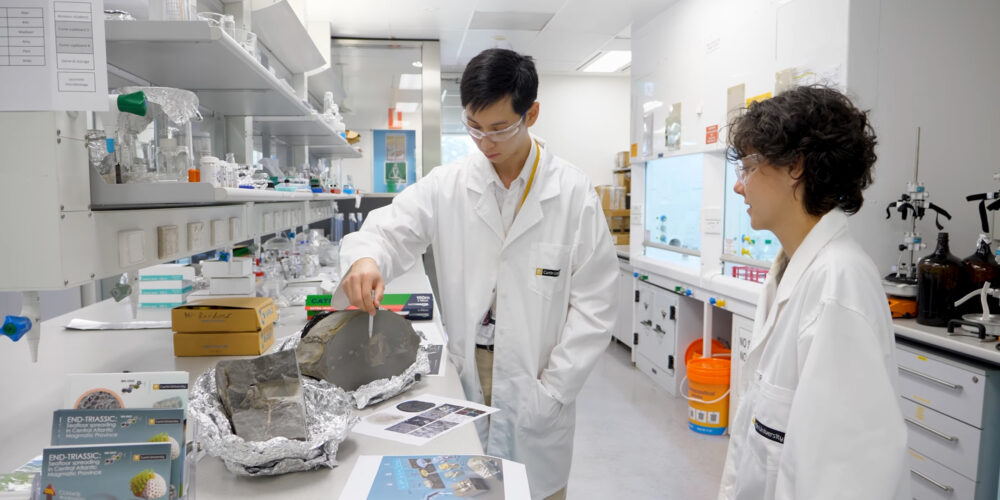
Methodologically, the project will combine non-destructive imaging techniques such as CT scanning and 3D modelling with targeted destructive analyses, including thin sectioning, SEM, and biomarker extraction. Advanced analytical tools such as ToF–SIMS and GC–MS will be employed to characterise both organic and inorganic components.
The research is also closely aligned with museum and public engagement objectives. Digital models and physical replicas generated through this work will contribute directly to exhibition design, while comparative Jurassic–Cretaceous narratives will enhance educational storytelling.
Ultimately, this research aims to advance understanding of ichthyosaur biology, preservation processes, and marine ecosystem evolution by bridging the gap between Jurassic and Cretaceous records through integrated molecular and morphological analysis.
Aim
The primary aim of this project is to conduct an integrated morphological and biomolecular investigation of Cretaceous and Jurassic ichthyosaurs to better understand their biology, preservation, and palaeoecological context across evolutionary time.
A central aim is to generate a comprehensive anatomical description of the Cretaceous specimen and compare it with other ichthyosaurs worldwide. This comparative approach will help identify evolutionary changes in morphology, including body proportions, locomotion, and potential ecological adaptations.
Another key aim is to investigate the processes responsible for exceptional soft tissue preservation across both Jurassic and Cretaceous contexts. By comparing preservation pathways between analogous deposits from these periods, the project seeks to determine whether similar microbial and geochemical mechanisms were involved or whether distinct processes operated under different environmental conditions.
The project also aims to extract and characterise biomarkers preserved within the Cretaceous specimen and compare these with existing biomolecular data from Jurassic ichthyosaurs. This will enable evaluation of biomarker preservation potential across geological time and provide insights into palaeoenvironmental conditions and dietary ecology.
A further aim is to integrate morphological and molecular datasets from both Jurassic and Cretaceous specimens to produce a holistic reconstruction of ichthyosaur palaeobiology. This will enable more robust interpretations of evolutionary and ecological trends.
Additionally, the project aims to contribute to museum outcomes by incorporating both Jurassic and Cretaceous perspectives into exhibition materials, enhancing public understanding of ichthyosaur evolution.
Finally, the project aims to disseminate findings through publications and collaborative research, strengthening interdisciplinary links.
Objectives
- Conduct detailed osteological analysis of the Cretaceous specimen and compare with other ichthyosaurs worldwide.
- Perform CT scanning and 3D reconstruction for both new and comparative datasets.
- Digitally segment anatomical structures for cross-period comparison.
- Undertake thin sectioning and SEM analysis to compare microstructures between Jurassic and Cretaceous specimens.
- Use TIMA to assess mineralogical differences in preservation pathways.
- Apply ToF–SIMS to compare chemical preservation across time intervals.
- Extract and analyse biomarkers using GC–MS and compare with Jurassic datasets.
- Apply hydropyrolysis to maximise organic recovery and assess preservation differences.
- Conduct comparative analysis with global Jurassic and Cretaceous ichthyosaur records.
- Translate findings into museum-ready outputs highlighting evolutionary change.
Significance
This project is highly significant because it bridges a critical gap between Jurassic and Cretaceous ichthyosaur research. While Jurassic ichthyosaurs are relatively well studied, particularly in terms of soft tissue preservation, Cretaceous representatives remain comparatively understudied. By integrating these records, the project provides a unique opportunity to examine evolutionary and preservational trends across time.
Scientifically, the project advances understanding in palaeontology, geochemistry, and taphonomy by applying an interdisciplinary framework. The comparison between Jurassic and Cretaceous biomolecular data is particularly novel and has the potential to reveal how preservation potential changes through geological time.
The research also contributes to understanding extinction dynamics by contextualising Cretaceous ichthyosaurs within a longer evolutionary framework that includes Jurassic baselines.
From a museum perspective, the ability to present a “then vs later” narrative (Jurassic vs Cretaceous) enhances public engagement and educational value.
Overall, the project significantly enhances both scientific knowledge and public understanding of ichthyosaur evolution and preservation.
Ideal Candidate
We are seeking a motivated PhD candidate with strong analytical and problem-solving skills. Applicants should have a background in geology, palaeontology, geochemistry, or a related discipline. Experience with laboratory techniques, imaging (e.g., SEM, CT), or geochemical analysis is highly desirable. Familiarity with organic geochemistry or fossil studies, particularly marine reptiles, is advantageous. The candidate must demonstrate excellent communication, organisation, and independent research skills. Additionally, the applicants should meet the eligibility criteria for entry into a PhD program at Curtin University.
This project is open to Domestic applicants only.
Internship
Through this project you will also have an internship opportunity at WESTERN AUSTRALIAN MUSEUM AM or AUSTRALIAN AGE OF DINOSAUR MUSEUM, WINTON, QUEENSLAND.
Scholarship
If you are identified as the preferred candidate for this project, you may be considered for an RTP scholarship.
Enquires and How to Apply
For enquires about this opportunity contact Professor Kliti Grice at K.Grice@curtin.edu.au
To formally apply submit an Expression of Interest to Professor Kliti Grice during the Central Scholarship round (July 1st – July 31st 2026)