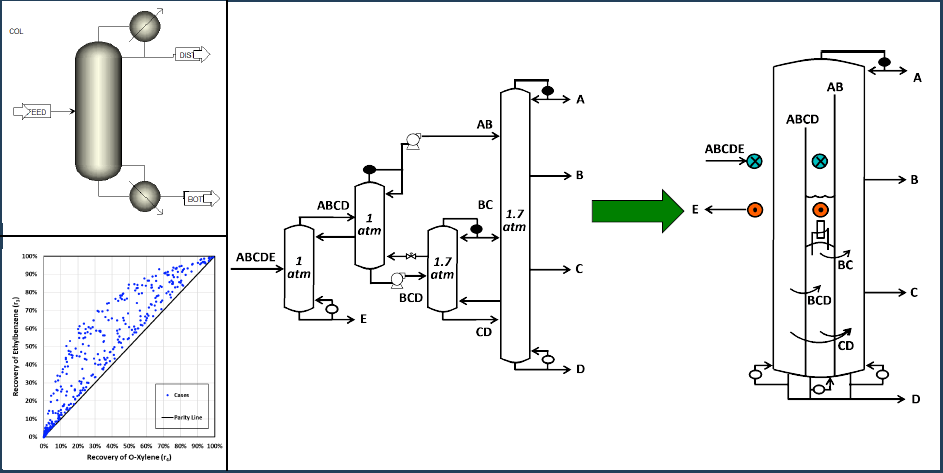
Distillation has existed for millennia at the homebrew scale, and for over a century at the industrial scale. It has become a standard part of chemical engineering education, and there are several commercial software tools for simulating distillation columns that are well-established and well-trusted by industry. Yet, difficulties still exist when attempting to design or simulate a distillation process to perform a desired multicomponent separation. While there have been several research advances over the past decades, the understanding and usage of these advances remains largely restricted to academia and have not been adopted by industry. Throughout this PhD, you will be discovering new results and enhancing the applicability of existing results, to aid industrial practitioners designing and simulating distillation processes.
Aim
• Discovering new results or creating new methods in distillation process design that are of industrial relevance
• Enhancing the accessibility of recent research advances in distillation process design for industry to bridge the gap with academia
Objectives
The specific objectives will be refined during discussions over the course of the PhD, but these are some example directions
• Developing improved methods for designing the initial guess when simulating distillation columns in process simulators (such as Aspen Plus or Aspen HYSYS)
• Discovering new insights and correlations about distillation columns by analysing their operating conditions
• Developing methods, which utilise existing published results, that industrial practitioners can employ in the design of distillation configurations for multicomponent separations
• Developing a structured method for guiding practitioners on how to improve a given distillation configuration using techniques of process intensification
Significance
Distillation is the predominant separations technology in the chemical and petrochemical industries. It is also estimated that 40-60% of the total cost for a chemical plant is due to separations, with 90-95% of liquid feed separations performed using distillation and operating cost being a dominant component. In the petrochemical industry, where roughly 81.6 million barrels of crude oil petroleum are processed each day across the world, distillation is the first unit operation, and it is estimated that crude oil refineries are responsible for 1.9% of the total greenhouse gas emissions in U.S.A. Distillation contributes to these emissions through fossil fuel combustion which is needed to supply heat for boiling. Lowering the energy consumption of distillation therefore lowers both separation cost (through reduced fossil fuel requirements) as well as greenhouse gas emissions. Thus, this project will contribute to meeting three sustainability development goals: # 7 (Affordable and Clean Energy), # 9 (Industry, Innovation, and Infrastructure) and # 13 (Climate Action).
Ideal Candidate
Essential Characteristics
• Has a Bachelor’s degree or higher having undertaken a substantial number of units involving a mixture of applied mathematical and computational analysis
• Is interested in coding mathematical algorithms
• Is willing to learn the concepts and gain the perspectives required to confidently tackle upgrading the industrial relevance of the research advances
• Must be eligible to enrol in PhD programs at Curtin
Preferred Characteristics
• Has a Bachelor’s degree majoring in Chemical Engineering, and has comfortable understanding of basic distillation
• Has good theoretical background in the concepts of mass and energy balance, chemical process flowsheets, algebraic analysis, and algorithm development
• Has undertaken research projects during their bachelor’s degree
• Is comfortable in engaging in critical thinking, rationalising and justifying the choices made as well as undertaking reflection and self-analysis
• Is interested in discovering or deepening understanding of behaviours that the given mathematical model of the real-world can exhibit
• Has strong verbal and written communication skills
Additionally, the applicants should meet the eligibility criteria for entry into a PhD program at Curtin University.
This project is open to Domestic applicants only.
Scholarship
If you are identified as the preferred candidate for this project, you may be considered for an RTP scholarship.
Enquires and How to Apply
For enquires about this opportunity contact Dr Tony Mathew at Tony.Mathew@curtin.edu.au
To formally apply submit an Expression of Interest to Dr Tony Mathew during the Central Scholarship round (July 1st – July 31st 2026)