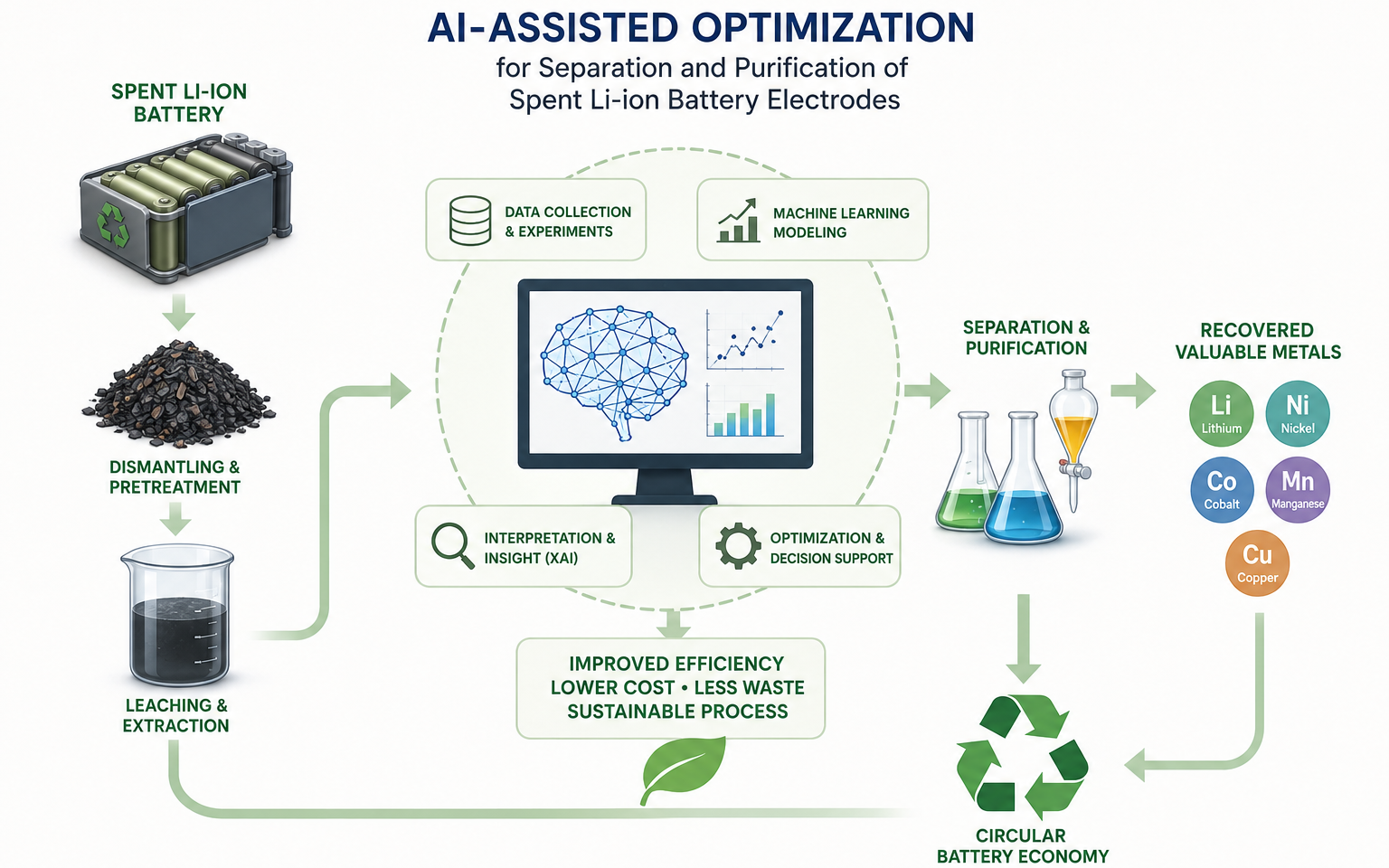
The rapid growth of electric vehicles, renewable energy storage systems, and portable electronic devices has led to a substantial increase in the global consumption of lithium-ion batteries (LIBs). As a consequence, the generation of spent LIBs is increasing rapidly, creating both environmental challenges and opportunities for resource recovery. Spent LIBs contain valuable critical metals such as lithium (Li), nickel (Ni), cobalt (Co), manganese (Mn), copper (Cu), and graphite, which are essential for modern energy technologies. Efficient recovery and purification of these materials are therefore becoming increasingly important for supporting the circular economy and securing critical mineral supply chains.
Conventional hydrometallurgical and pyrometallurgical recycling methods often suffer from high chemical consumption, complex process interactions, poor selectivity, and significant operational costs. In addition, the separation and purification stages of LIB recycling are highly nonlinear and involve multiple interacting variables, including pH, reagent dosage, temperature, oxidation-reduction potential, solid-liquid ratio, extraction time, and impurity concentrations. Traditional optimization methods are often insufficient for accurately predicting process performance under such complex conditions.
Machine learning (ML) techniques provide new opportunities for improving LIB recycling efficiency through data-driven process modelling, prediction, and optimization. However, many ML models operate as “black boxes” and provide limited interpretability for industrial implementation. Interpretable machine learning (IML) approaches can address this challenge by providing transparent explanations of model predictions, identifying dominant process variables, and supporting decision-making in process design and optimization.
This project aims to develop interpretable machine learning-assisted frameworks for optimizing the separation and purification of spent LIB electrodes. The research will integrate experimental hydrometallurgical processing with advanced ML algorithms and explainable artificial intelligence (XAI) techniques to improve metal recovery efficiency, impurity removal, process stability, and sustainability. The project outcomes are expected to contribute to the development of intelligent and sustainable battery recycling technologies for future circular economy applications.
Aim
The primary aim of this project is to develop interpretable machine learning-assisted strategies for optimizing the separation and purification processes of valuable metals from spent lithium-ion battery electrodes.
- The project also aims to:
- Improve the recovery efficiency and purity of critical battery metals including Li, Ni, Co, and Mn.
- Develop predictive machine learning models capable of accurately estimating process performance under varying operational conditions.
- Apply interpretable artificial intelligence techniques to identify critical process variables and establish transparent process-performance relationships.
- Reduce chemical consumption, energy use, and waste generation during LIB recycling.
- Provide intelligent decision-support tools for sustainable and industrially scalable battery recycling operations.
Objectives
The specific objectives of this research project are:
- Conduct a comprehensive literature review on spent LIB recycling technologies, hydrometallurgical separation methods, machine learning applications in mineral and chemical processing, and interpretable AI techniques.
- Characterize spent LIB electrode materials using advanced analytical techniques such as XRD, SEM-EDS, ICP-OES, XPS, and particle size analysis to determine mineralogical and chemical compositions.
- Investigate hydrometallurgical leaching, solvent extraction, selective precipitation, ion exchange, and purification processes for recovering valuable metals from spent LIB electrodes.
- Generate high-quality experimental datasets under varying operational conditions, including pH, reagent concentration, extraction time, temperature, liquid-solid ratio, and impurity concentration.
- Develop machine learning models such as Random Forest, XGBoost, Artificial Neural Networks, Support Vector Machines, and Gaussian Process Regression to predict metal recovery and purification performance.
- Apply interpretable machine learning and explainable AI methods, including SHAP (Shapley Additive Explanations), feature importance analysis, and sensitivity analysis, to identify dominant process variables and explain model predictions.
- Develop optimization frameworks integrating machine learning and experimental validation to improve recovery efficiency, selectivity, and sustainability.
- Evaluate the environmental and economic implications of the proposed optimized recycling processes through techno-economic and sustainability assessments.
- Produce high-quality journal publications and industry-relevant recommendations for intelligent LIB recycling system design and operation.
Significance
This project addresses critical global challenges associated with sustainable resource recovery, critical mineral supply security, and battery waste management. The rapid expansion of electric vehicles and renewable energy systems is expected to significantly increase the volume of spent LIBs worldwide. Developing efficient recycling technologies is therefore essential for reducing environmental impacts and supporting sustainable energy transitions.
The proposed research is significant because it integrates advanced machine learning and explainable AI approaches with separation and purification engineering. While ML applications in chemical and mineral processing are increasing, many studies remain limited by poor interpretability and insufficient industrial transparency. This project will bridge the gap between advanced data analytics and practical process engineering by developing interpretable ML models that provide both predictive capability and mechanistic insight.
The project is also expected to deliver:
- Improved recovery and purification efficiency for critical battery metals.
- Reduced reagent consumption and operational costs.
- Enhanced process understanding through explainable AI.
- Intelligent optimization strategies for industrial recycling systems.
- Contributions to circular economy and sustainable resource management.
- Support for Australia’s critical minerals and battery recycling industries.
The research outcomes may have broader applications beyond LIB recycling, including mineral processing, hydrometallurgy, wastewater treatment, and resource recovery systems involving complex multivariable interactions.
Ideal Candidate
Applicants with the following background and skills are preferred:
- Bachelor Honours or Master degree in Chemical Engineering, Metallurgical Engineering, Materials Science, Mineral Processing, Environmental Engineering, Data Science, or related disciplines.
- Knowledge of hydrometallurgy, mineral processing, separation technologies, or electrochemical systems.
- Experience in laboratory experimentation and analytical characterization techniques.
- Basic programming and data analysis skills using Python, MATLAB, R, or similar platforms.
- Interest in machine learning, artificial intelligence, and sustainable resource recovery.
- Strong written and verbal communication skills.
- Ability to work independently and collaboratively in multidisciplinary research environments.
Experience in battery recycling, computational modelling, process optimization, or machine learning will be advantageous, but is not mandatory.
Additionally, the applicants should meet the eligibility criteria for entry into a PhD program at Curtin University.
This project is open to International and Domestic applicants.
Internship
The project offers strong potential for internship and industry engagement opportunities during the study period. The supervisory team maintains active collaborations and professional connections with industry partners, research organizations, and higher education institutions involved in battery recycling, hydrometallurgy, critical minerals, process engineering, and sustainable resource recovery. Depending on project progress and partner availability, the candidate may have opportunities to undertake internships, industry placements, collaborative research activities, or short-term professional training programs. These experiences are expected to provide valuable exposure to real-world industrial challenges, advanced analytical and processing technologies, data-driven optimization approaches, and interdisciplinary research environments. Internship opportunities may also support the development of practical skills, professional networks, and future employment pathways within academia, research organizations, and the resource and recycling industries.
Scholarship
If you are identified as the preferred candidate for this project, you may be considered for an RTP scholarship.
Enquires and How to Apply
For enquires about this opportunity contact Dr Lisha Dong at Lisha.Dong@curtin.edu.au
To formally apply submit an Expression of Interest to Dr Lisha Dong during the Central Scholarship round (July 1st – July 31st 2026)