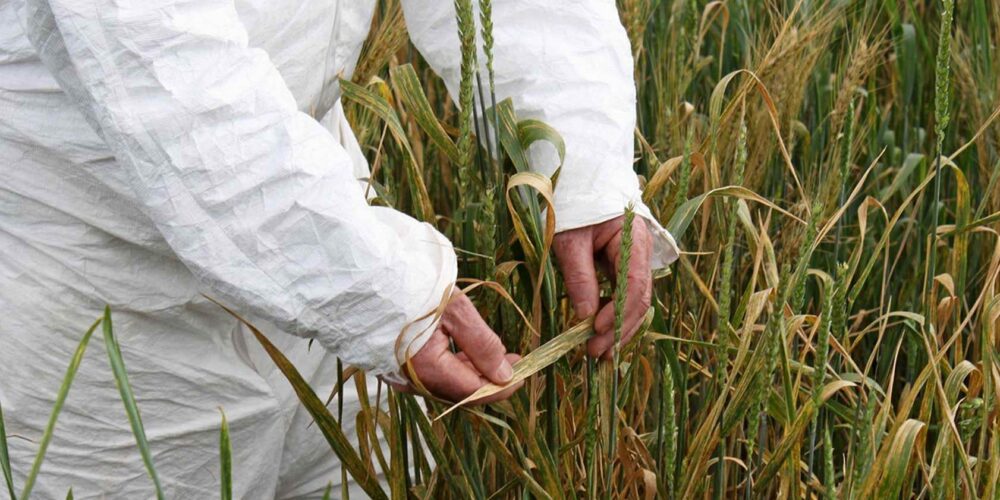
Crop disease detection from remote sensing data is moving toward multimodal deep learning, but progress is challenged with limited labels, weak cross-site generalization, and poor robustness across crop stages, illumination, and sensor platforms. This PhD will develop advanced deep learning framework for early crop disease detection using multiscale hyperdimensional imagery, integrating co-aligned hyperspectral and LiDAR observations to capture both spectral and plant structural features.
Aim
The research aims to produce deep learning models that are accurate, transferable, explainable, and suitable for field deployment in precision crop management.
Objectives
- Develop a curated benchmark dataset of co-registered hyperspectral and LiDAR imagery for crop disease detection.
- Design and benchmark deep learning models for spectral-spatial-structural disease classification and severity estimation.
- Investigate multiscale fusion strategies, including CNN, Transformer, and state-space model variants.
- Improve label efficiency and robustness using self-supervised learning, weak supervision, and domain adaptation.
- Produce interpretable and uncertainty-aware outputs suitable for agronomic decision support.
- Validate model transferability across crops, sites, seasons, and sensor configurations.
Significance
Crop diseases remain significant constraints on crop productivity. One effective mechanism to reducing the impacts of crop disease is early detection that enables early intervention. Hyperspectral remote sensing has a potential to provide actionable early detection. However, several hurdles have limited its widespread use under real-world situations. This project will work on addressing some of the challenges that may allow use of this technology for early field crop disease detection.
Ideal Candidate
The candidate should have strong programming ability and a strong interest in machine learning, computer vision, or remote sensing. Experience with deep learning frameworks, handling hyperspectral data, geospatial analysis, and reproducible workflows is highly desirable. The candidate should also be willing to learn plant pathology, data annotation, and field-based sensing workflows. Curiosity, persistence, and comfort working across disciplines are more important than prior expertise in every component. Additionally, the applicants should meet the eligibility criteria for entry into a PhD program at Curtin University.
This project is open to International and Domestic applicants.
Scholarship
If you are identified as the preferred candidate for this project, you may be considered for an RTP scholarship.
Enquires and How to Apply
For enquires about this opportunity contact Dr Ayalsew Zerihun at A.Zerihun@curtin.edu.au
To formally apply submit an Expression of Interest to Dr Ayalsew Zerihun during the Central Scholarship round (July 1st – July 31st 2026)