Powerful radio galaxies in the distant Universe act as probes of neutral hydrogen via absorption of the 21-cm hyperfine structure line. Observations can be sensitive to both neutral hydrogen within the galaxy as well as along the line of sight. Neutral hydrogen is fuel for star formation so is important to trace in the early Universe. Furthermore, above redshift z ≅ 6.5 this absorption can trace the reionisation of the neutral hydrogen which permeated the early Universe before stars and galaxies formed – a time known as the Epoch of Reionisation (EoR).
Aim
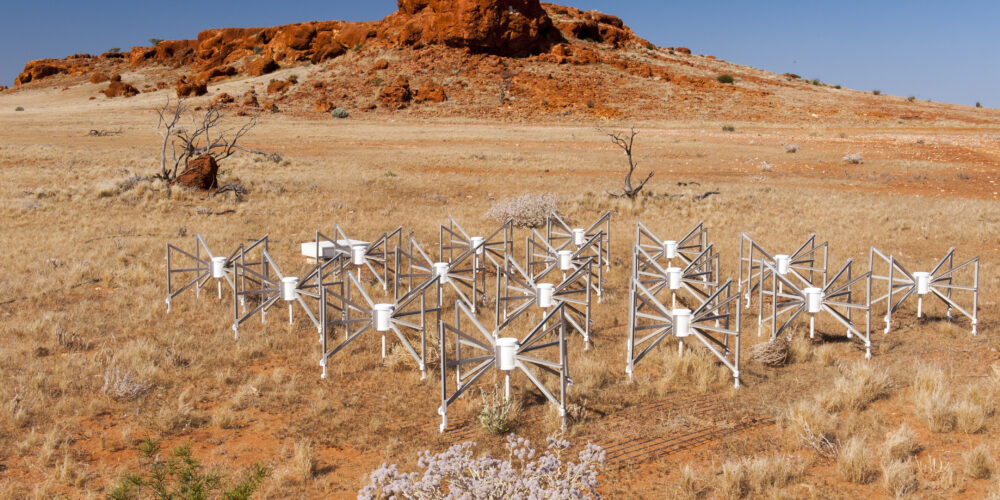
At high redshifts, the 21-cm line is redshifted to low radio frequencies so telescopes such as the Murchison Widefield Array (MWA) are ideally placed to conduct spectral line observations of high redshift radio galaxies. Creating such spectra is complicated due to the wide-field of view and the large data volume. An additional complication is the lack of bright radio sources in the distant Universe with the most distant bright radio lying at z ≅ 5.5, however this is a rapidly evolving field with new high redshift radio galaxies being discovered frequently. This project will use the MWA to study neutral hydrogen in the early Universe.
Objectives
(a) Aid in the search for new high-z radio galaxies from MWA and larger area optical/near-IR surveys.
(b) Develop and test various methods to produce 1D spectra of targets from low frequency telescopes such as the MWA.
(c) Run these pipelines on known high redshift radio galaxies with data in the archive.
(d) Propose and process observations on new targets as appropriate.
(e) Detect and/or constrain the neutral hydrogen content in these radio galaxies
(f) Provide baseline observations for commissioning and early science with the SKA.
Significance
This work will complement on-going attempts to detect and characterise the EoR via power spectrum techniques with the MWA and other telescopes. Furthermore, measuring the EoR is a key science goal of the SKA. A direct detection of any absorption feature at low frequency with the MWA will provide a baseline observation for commissioning and early science observations with the SKA_LOW telescope.
Ideal Candidate
We are looking for a self-motivated PhD candidate with a background in physics, astronomy, or computing/data science. Candidates with strong computing skills or the willingness to develop them are desired for this project. Additionally, the applicants should meet the eligibility criteria for entry into a PhD program at Curtin University.
This project is open to Domestic applicants only.
Internship
This project comes with the opportunity for an industry internship at CSIRO’s Australian Telescope National Facility. You will spend 60 days working with CSIRO researchers on a related technical issue.
Scholarship
If you are identified as the preferred candidate for this project, you may be considered for an RTP scholarship.
Enquires and How to Apply
For enquires about this opportunity contact Dr Nick Seymour at Nick.Seymour@curtin.edu.au
To formally apply submit an Expression of Interest to Dr Nick Seymour during the Central Scholarship round (July 1st – July 31st 2026)