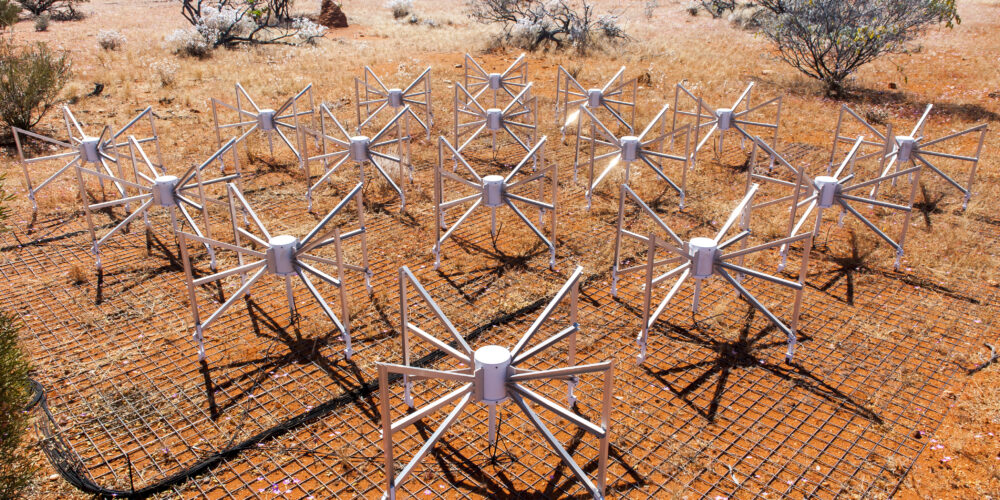
Modern wireless communication, sensing and radio astronomy systems increasingly rely on phased array antennas for high gain, adaptive beamforming, interference suppression and custom coverage beam patterns. Next-generation wireless networks, satellite communications, radio telescopes and autonomous sensing systems require arrays with increasingly complex geometries and performance specifications. However, conventional automated synthesis methods rely on computationally expensive optimisation procedures and repeated electromagnetic simulations, leading to long design cycles and poor scalability in large design spaces. Recent advances in artificial intelligence offer opportunities to transform antenna design from simulation-driven iterative workflows into data-driven methodologies. Artificial neural networks provide a promising framework for modelling antenna arrays, although they typically require large training datasets that are not always practical to obtain. Representing antenna layouts as graph structures may enable more efficient learning and reduced data requirements, allowing automated synthesis of phased array configurations directly from desired electromagnetic performance targets. This project investigates neural network–based approaches for automated phased array antenna layout synthesis. The research will develop machine learning models that learn relationships between array geometry, electromagnetic response and design constraints to generate optimal or near-optimal antenna layouts. The project aims to deliver scalable design methodologies applicable across frequency ranges and antenna technologies, from low-frequency radio astronomy arrays to high-frequency massive MIMO systems.
Aim
The aim of this project is to develop and validate artificial neural network models capable of automatically synthesising phased array antenna layouts from user-defined electromagnetic performance requirements, including gain, beamwidth, sidelobe levels, null placement and coverage constraints.
Objectives
- Develop datasets containing diverse phased array configurations together with their corresponding electromagnetic performance metrics.
- Investigate suitable neural network models, including graph-based representations, of antenna arrays that capture spatial relationships, electromagnetic coupling and array topology.
- Design and train architectures capable of predicting optimal or near-optimal antenna layouts from desired radiation characteristics.
- Evaluate the accuracy, computational efficiency and generalisation capability of the developed models against conventional optimisation-based synthesis techniques.
- Investigate the generation of novel array geometries suitable for applications spanning radio astronomy, wireless communications and next-generation adaptive antenna systems.
- Validate the proposed methodologies through electromagnetic simulations, prototyping, measurements and performance benchmarking.
Significance
This project addresses a major challenge in antenna engineering: the computational complexity associated with phased array design and optimisation. By replacing iterative optimisation workflows with deep learning prediction models, there is a potential to significantly reduce design time and computational requirements while enabling rapid exploration of large design spaces. The proposed research represents an important step toward AI-assisted electromagnetic design methodologies capable of supporting increasingly complex communication and sensing systems. The ability to generate near-real-time layout recommendations could enable adaptive, reconfigurable and autonomous antenna systems that respond dynamically to changing operating conditions. The project also contributes to the rapidly growing intersection between artificial intelligence and radio frequency engineering by introducing novel machine learning approaches for electromagnetic design problems. Outcomes from this research have potential applications across multiple sectors, including radio astronomy, satellite communications, defence, remote sensing and airborne wireless networks.
Ideal Candidate
We are seeking a highly motivated PhD candidate with strong analytical, problem-solving and communication skills. Applicants should have a background in electrical and electronic engineering, telecommunications engineering, computer engineering, physics or a related discipline. Experience in antenna engineering, electromagnetics, wireless communications, machine learning, artificial intelligence or computational modelling is desirable. Familiarity with programming (e.g., MATLAB or Python) is required, understanding numerical methods is advantageous. Candidates must be eligible for admission into a PhD program at Curtin University.
This project is open to Domestic applicants only.
Scholarship
If you are identified as the preferred candidate for this project, you may be considered for an RTP scholarship.
Enquires and How to Apply
For enquires about this opportunity contact Dr Maria Kovaleva at Maria.Kovaleva@curtin.edu.au
To formally apply submit an Expression of Interest to Dr Maria Kovaleva during the Central Scholarship round (July 1st – July 31st 2026)