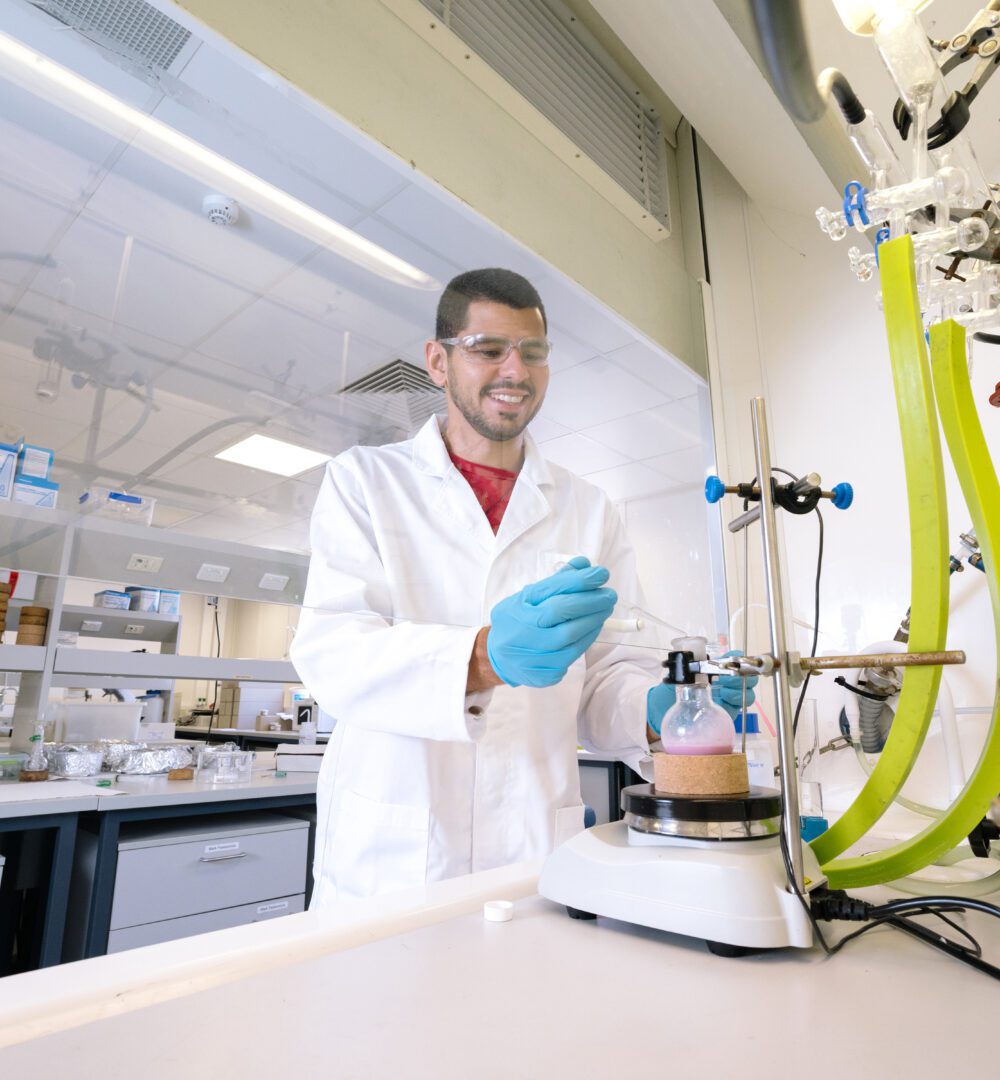
Earth scientist working in scrub landscape
MJRU-EARTH

Earth Sciences

Undergraduate major

Get the expertise for a career in industries involved in sustainable use of Earth resources, energy transition, and climate and environmental solutions.

Course outline
  • Qualification
    Earth Sciences Major (BSc Science)
  • Credit

    Credit

    200
Course outline

You can study this course as part of the following degrees

Visit your preferred degree page for information on admission criteria, course fees and study locations.

Course outline

Overview

Overview

Earth scientists are essential to meeting society's future challenges around climate and environmental change, sustainable extraction of critical resources such as water, and minerals for new and emerging technologies.

Across a range of industries, Earth scientists use sophisticated instruments to determine the properties of Earth and planetary materials, and to help understand the evolution of the Earth and the controls and direction of its climate and biosphere.

In this course, you will gain advanced knowledge in Earth sciences and learn how to apply that knowledge to scientific, social and ethical issues. You'll also use digital technologies and learn to gather and interpret data that are relevant to Earth sciences applications and careers.

Earth Sciences is also available as a major in the Advanced Science (Honours) course.

Double degrees

You can extend your expertise and career opportunities by studying Earth Sciences as a double degree Environmental Engineering, Innovation or Law.

How this course will make you industry ready

During your course you’ll use to use digital technologies and relevant industry methods of data acquisition and interpretation.

What jobs can the Earth Sciences course lead to?

Careers

  • Earth scientist
  • Environmental geoscientist
  • Hydrogeologist
  • Geochemist
  • Geologist
  • Geotechnician

Industries

  • Resources and mining
  • Environmental remediation and protection
  • Geological surveys
  • Earth sciences research

What you'll learn

  • exhibit a well-developed depth and breadth of knowledge, critical understanding and ability to apply this in Earth sciences, particularly with respect to the geosphere and it’s interaction with the hydrosphere, atmosphere and biosphere, GC1
  • select, innovate and apply field, laboratory, remote sensing and data techniques as appropriate, to address problems in the understanding of Earth systems and management of its resources via the design and development of investigations, and the accurate and ethical collection, analysis, visualisation, and interpretation of data and other forms of evidence, demonstrating awareness of limitations and reliability, GC2
  • synthesise, critically evaluate, and communicate information, arguments and ideas around Earth sciences, natural processes and resources and planetary evolution, demonstrating awareness of underlying assumptions and scientific merit; communicate across written, visual and oral modes, in face to face and digital contexts, and for a range of purposes and audiences, GC3
  • be adaptable within evolving professional contexts within the Earth sciences and adjacent sectors, demonstrating awareness of global citizenship and sustainability principles, particularly with respect to Earth systems and resources, and a capacity to engage with complex global problems and stakeholders from a range of disciplines, backgrounds and communities, GC4
  • demonstrate a coherent and reflective understanding of the nature of Earth sciences, the core ethics, the social and cultural context of its concepts and endeavour, and the contributions of different global knowledge systems, including Indigenous perspectives and practices, especially around Earth observation, natural resources, and relationship to Country, GC5
  • demonstrate integrity and reflective and ethical professional behaviours, including responsible self-direction and collegial collaboration; working safely in diverse environments, including laboratory and field sites; showing respect for others’ voices, knowledge, ownership and agency, including cultural protocols and IP; and cognisance of all appropriate regulatory, cultural and professional considerations within and adjacent to the Earth science sector, GC6

Admission criteria

What you need in order to get into this course. There are different pathway options depending on your level of work and education experience.

Select an option that best suits you:

You’re considered a high school leaver if you:

  • Completed year 12 in Australia or overseas in the past two years, or
  • Completed TAFE or VET studies in the past two years.

ATAR pathway

  • Essential WACE subjects (prerequisites)

    Essential WACE subjects (prerequisites)

    There are no essential WACE subjects for this course.

  • Desirable WACE subjects

    Desirable WACE subjects

    There are no desirable WACE subjects for this course.

Please see our correlation comparability for previous TEE subjects, WACE courses and WACE ATAR courses.

StepUp Entry

StepUp Entry

Successful StepUp Entry and StepUp Equity Adjustment Admission Pathway (StepUp Bonus) applicants will be eligible to be considered for admission into this course.

Alternative pathways

English requirements

Curtin requires all applicants to demonstrate proficiency in English. Specific English requirements for this course are outlined in the IELTS table below.

You may demonstrate English proficiency using the following tests and qualifications.

IELTS Academic (International English Language Testing System)

Writing

6

Speaking

6

Reading

6

Listening

6

Overall band score

6

Find your pathway to Curtin

Think you don’t have the marks or qualifications to study at Curtin? We have several pathways to help you meet admission. Use our pathway finder to find your best way to studying with us.

Pathway finder tool

How others gained admission

View the ATAR breakdown to see the low, median and high ATAR scores of students who started studying this course recently.

To see the other pathways students have taken, see the pathway breakdown.

Application Requirements

You’re considered someone who has recently left university if:

Applicants with higher education are those whose highest level of study since leaving secondary education is a higher education course, such as a university degree. This may include applicants who are currently studying a higher education course at another education provider and want to transfer to Curtin University, or applicants who are currently studying at Curtin but want to switch to a different course. It may also include applicants who have completed past study with university and non-university higher education providers.

English requirements

Curtin requires all applicants to demonstrate proficiency in English. Specific English requirements for this course are outlined in the IELTS table below.

You may demonstrate English proficiency using the following tests and qualifications.

IELTS Academic (International English Language Testing System)

Writing

6

Speaking

6

Reading

6

Listening

6

Overall band score

6

Find your pathway to Curtin

Think you don’t have the marks or qualifications to study at Curtin? We have several pathways to help you meet admission. Use our pathway finder to find your best way to studying with us.

Pathway finder tool

Application Requirements

Unsure what option suits you?

We’re here to help you navigate the complexities of university admission. Choose the support you need from the options below.

Find your pathway to Curtin

Think you don’t have the marks or qualifications to study at Curtin? We have several pathways to help you meet admission. Use our pathway finder to find your best way to studying with us.

Pathway finder tool

Application Requirements

Credit for recognised learning (CRL)

Use your experience to get credit towards your degree

Finish your course sooner with credit for your previous study or work experience.

Fees and scholarships

Please view the Bachelor of Advanced Science degree for indicative fees.

Looking for more detail on the course structure?

View course structure

How to apply

Please review information on how to apply for the campus of your choice

Apply now
  • The offering information on this website applies only to future students. Current students should refer to faculty handbooks for current or past course information.

    The information on this page may be subject to change. In particular, Curtin University may change the content, method or location of delivery or tuition fees of courses.

    While Curtin uses reasonable efforts to ensure that the information provided on this page is accurate and up to date, errors and omissions sometimes occur. Curtin makes no warranty, representation or undertaking (expressed or implied) nor does it assume any legal liability (direct or indirect) for the accuracy, completeness or usefulness of any information.

    View courses information disclaimer.

  • Curtin course code: MJRU-EARTH
  • Last updated on: 7 March 2026

Got a question? We’re here to help.

Call 1300 222 888 Send us an email Ask us a question Book an appointment

Bachelor of Business Administration (BBA) Specialisations

Bachelor of Commerce Specialisations

Bachelor of Innovation Specialisations

Learn more about Commerce

Apply for Earth Sciences Major (BSc Science)