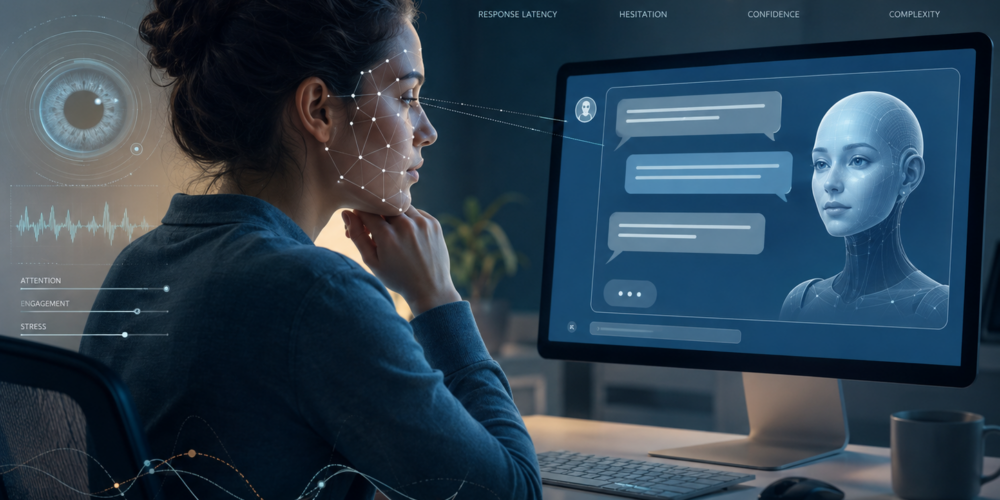
Conversational AI is quietly rewriting how we assess people. For example, chatbots can now interview a person and produce credible estimates of their personality, values, vocational interests, skills, and motivation. These assessments used to require a trained psychologist or a long questionnaire. Organisations are already deploying these tools in hiring, and the same logic is being explored for security screening, clinical triage, and beyond.
Unfortunately, whenever an assessment matters, some people will try to game it. A job applicant may want to look like the ideal candidate even if they are not. A traveller at a country’s border may want to look like an innocent tourist when they have other intentions. We are learning that chatbot-based assessments can be valid when people answer honestly. We still know very little, however, about how easily they can be faked. What strategies do people use? Can a chatbot be built to notice and adapt to attempts at deception? Does the body movement give away what the words conceal during an interview with a chatbot? This PhD sets out to answer these questions!
Aim
You will design and run experiments in which people interact with conversational AI agents under different instructions: respond honestly, “faking good” (e.g., presenting as the perfect job applicant), “faking bad” (e.g., trying to simulate a mental illness), or actively try to deceive or derail the system.
While they do so, we capture the transcript, their behaviours, eye gaze movements, pupillometry, and automated facial expression analysis, allowing you to ask whether the physiological signature of deception is detectable alongside, or instead of, the linguistic cues, and if responding to different interviewing approaches emphasises these behaviours/cues further.
Objectives
You will have some flexibility in setting the project, and directions the project could take include:
- Mapping faking strategies. What do people actually do when they try to fake a conversational assessment? Do they inflate, fabricate, mirror the interviewer, or manage impressions more subtly than they could in a questionnaire?
- How much does faking distort the result? Comparing honest and instructed-faking conditions to quantify the damage to score validity.
- Building a chatbot that pushes back. Can conversational agents be prompted, structured or trained to probe inconsistency, follow up on implausible claims, or raise the cognitive cost of lying?
- Detection from behaviour and biometrics. Whether gaze patterns, pupil dilation, facial expression, response latency and linguistic features carry diagnostic signal — alone or combined.
- Red teaming. Can the assessment be derailed, jailbroken or manipulated by a determined participant? What does that imply for high-stakes deployment?
- Doing it responsibly. Deception detection is ethically loaded territory. Thinking carefully about false positives, candidate rights, transparency and appropriate use is part of the work, not a footnote to it.
You won’t be expected to do all of this! You and your supervisors will shape a coherent thesis from the parts that most interest you.
Significance
What you’ll gain:
- Deep expertise in an area that is genuinely new and fast-growing, chatbot-based psychometrics, faking and response distortion, and AI-assisted scoring of open-ended data,
- Hands-on skills with biometric methods (eye tracking, pupillometry, facial expression coding) and with using large language models as both research instruments and analysis tools,
- Experimental design and advanced quantitative training in one of Australia’s strongest applied psychology research environments,
- Membership of an active research team working on related questions, including another PhD student at Curtin on an adjacent project, and/or
- Research with obvious relevance to employers, assessment vendors and government agencies, and clear pathways into academia, applied psychometrics, people analytics or AI evaluation.
Ideal Candidate
Who we’re looking for:
We expect strong applications from two directions, and we’re interested in both.
If you have a background in psychology or organisational behaviour, you’ll bring the measurement and experimental thinking, and you’ll get to build serious technical skills with AI systems and biometric data.
If your background is in AI, data science, computer science or machine learning and you’ve always been curious about human behaviour, you’ll bring the technical edge and learn rigorous psychological science alongside it.
Either way, we’re looking for someone curious, careful and willing to work at the seams between disciplines. Comfort with statistics is important; existing coding ability is a plus rather than a prerequisite.
This project is open to Domestic applicants only.
Scholarship
The project is supported by a Office of National Intelligence (ONI) Discovery Grant and includes a living stipend of $47,000 p.a. pro rata indexed, based on full-time study, for up to a maximum of 3 years.
The applicant will be required to complete an ONI Personnel Declaration Form.
Enquires and How to Apply
For enquires about this opportunity contact Professor Patrick Dunlop at Patrick.Dunlop@curtin.edu.au. To formally apply submit an Expression of Interest to Professor Patrick Dunlop.
Applications open 14 September 2026 and Close 30 October 2026.
Learn more about the PhD experience at the Future of Work Institute here: https://www.futureofworkinstitute.com.au/study


Our faculties and centres
Explore those leading the challenge through our specialist school teaching staff.