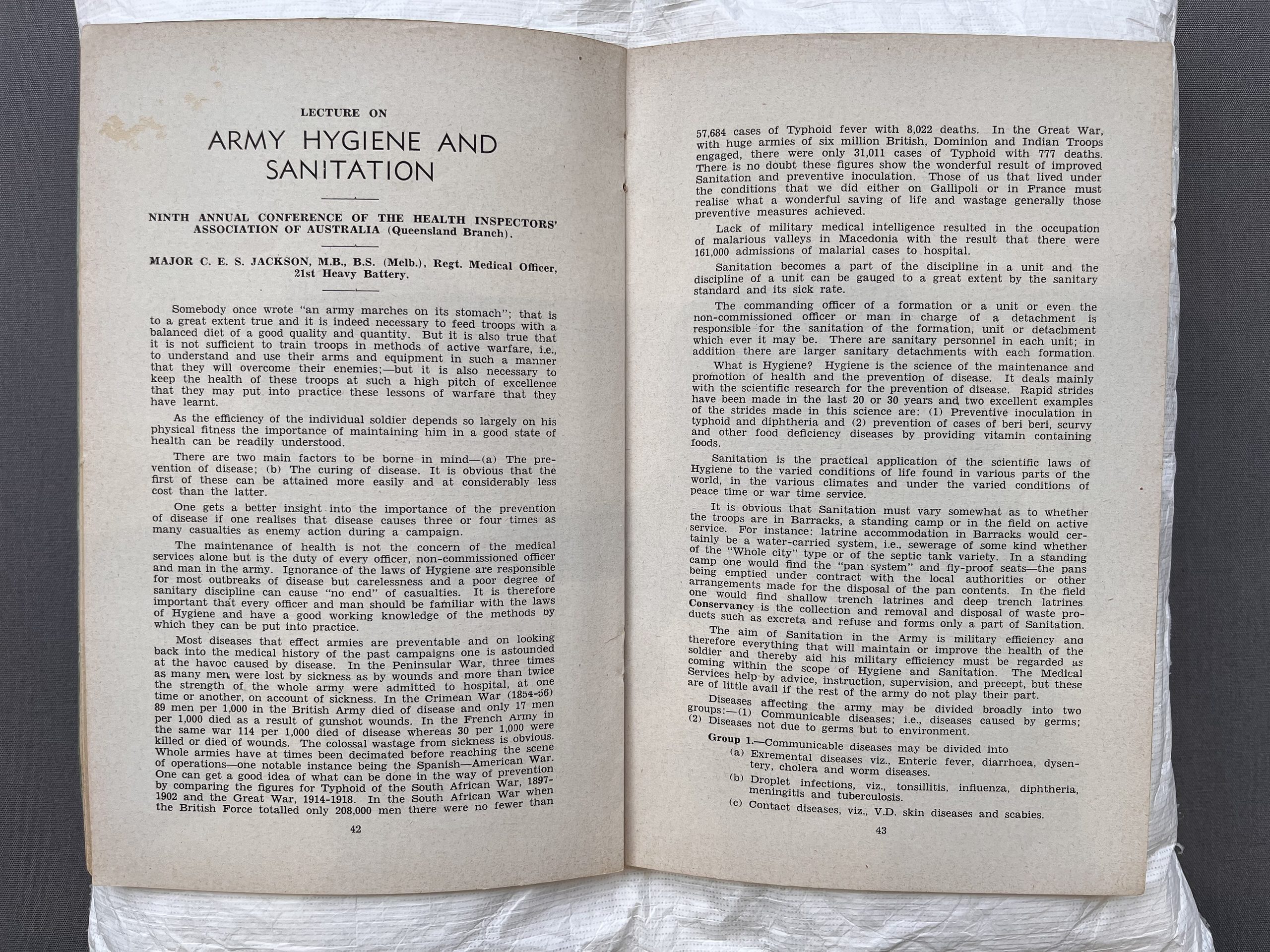
In a box containing records of the early days of Occupational Therapy in Australia there is a collection of Year Books belonging to the Health Inspectors’ Association of Australia.
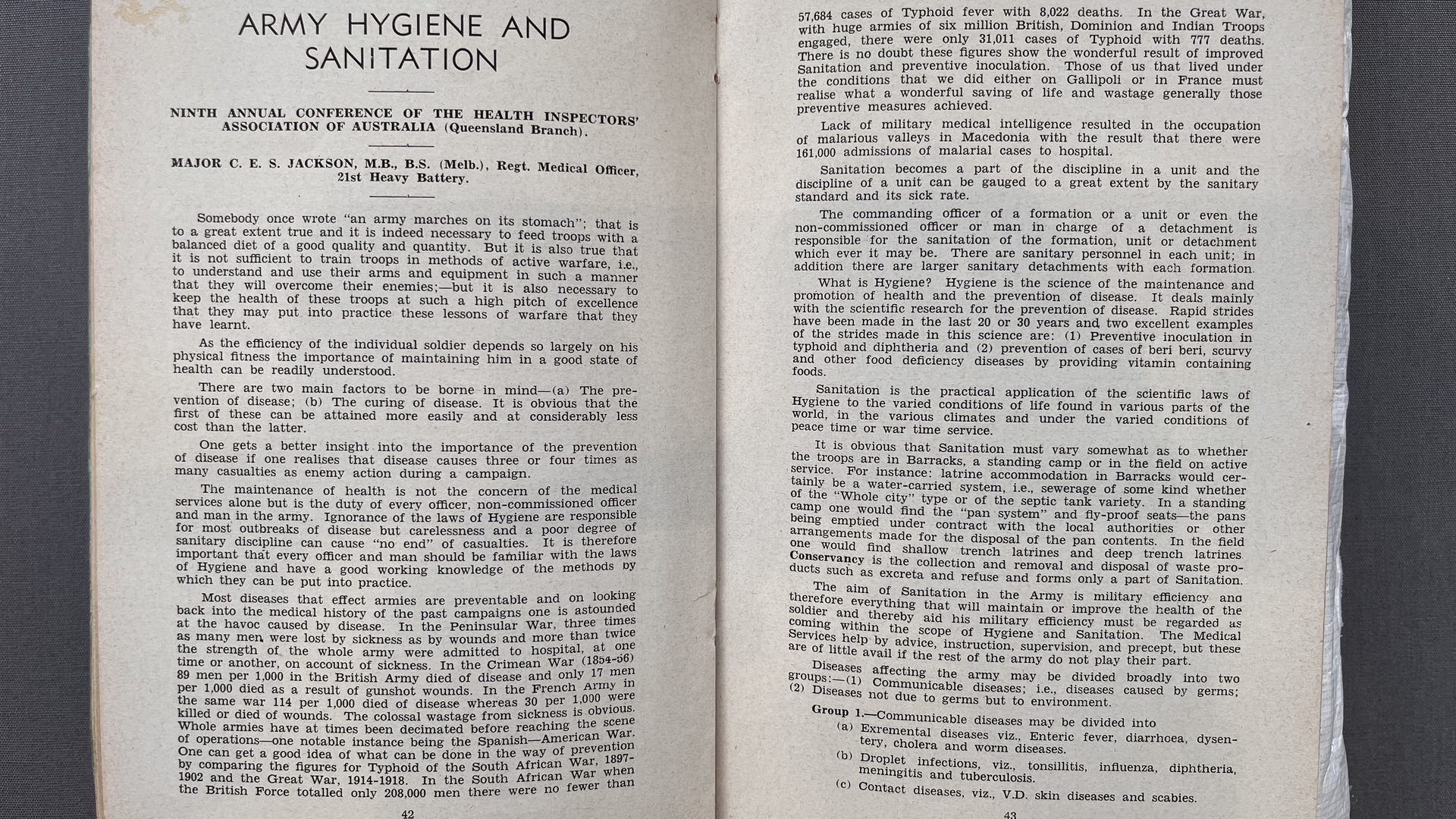
The 1939 Year Book contains a lecture called “Army Hygiene and Sanitation” written by a Major C. E.S. Jackson, M.B.B.S (Melb), Regimental Medical Officer, 21st Heavy Battery.
Major Jackson served as a private during the Gallipoli campaign. He recounted his experiences relating to the lack of water during the Gallipoli campaign:
On Gallipoli, where it was very hot, the men in the same machine gun section as myself only got one water bottle of water for the 24 hours for all purposes. Most of us had dysentery and that drained fluid from our systems. We sweated too, partly from the heat and partly from muscular work (digging trenches, sinking roads, constructing machine gun tunnels) The tunnels ran out into no-man’s land with a small crust of earth above each tunnel, the machine gunners sat at the end of each tunnel in a small circle).
Water came in from Alexandria and Malta in barges in sealed kerosene tins. Long queues would form to draw water, all supervised by a military police officer. Jackson described the system for obtaining water at Gallipoli:
As machine guns must have water for cooling purposes, armed with a chit or order the machine gunner (Jackson) got preference and went to the head of the queue…. we’d then travel back to our bomb-proof as quickly as we could and drink that extra water.
Jackson goes on to say
…it is extraordinary how thirsty one gets after being in a nasty attack. On the 7th of August I was one of the few left in the 8th Light Horse after our attack at dawn across the Neck [Nek] on that date. I’ll never forget those ashen-faced survivors draining their water in one gulp.
Hundreds of men died that day, ordered to repeatedly charge against the massed rifles and machine guns of the Turkish soldiers across a narrow strip of land. This action became known as the “Charge at the Nek”.
Out of 300 men in the 8th Light Horse, 154 died in the charge; many were wounded. Jackson was one of the lucky few to emerge without physical injuries.
The 9th and 10th Light Horse also were part of the charge and suffered terrible losses. The 10th was a Western Australian Regiment and 80 men from this regiment died that day.
The Charge was depicted in the 1981 film “Gallipoli”.
Charles Ernest Sandleford Jackson
Charles Ernest Sandleford Jackson was a 20-year-old medical student (University of New South Wales) when he enlisted in 1914. He embarked for Gallipoli on May 16th, 1915, from Alexandria and contracted dysentery and then typhoid while there.
Jackson was invalided back to Australia in November 1915, medically discharged from service in February 1916 and resumed his medical studies. He returned to the military service as a medical practitioner, served in World War Two and retired in 1947. He died in 1951. Jackson Service Record
The records of early Occupational Therapists
This 1939 Year Book paper, which came to us from our early Occupational Therapy staff as part of much larger collection of documents, provided a glimpse of a formative event in our national history. It was delivered in a pragmatic fashion at a conference as part of a lecture about army hygiene, water supply and sanitation.
The papers, photographs, objects, and documents in this Collection also show the development of Occupational Therapy in Australia and the topics and fields of study that interested our early Occupational Therapists. When World War One was over, many returning servicemen came back with physical damage and trauma that affected the rest of their lives. Sometimes they had to change how they conducted their lives; what they could for an occupation or trade or change how they physically performed their former work. These pioneering Occupational Therapists had an important role in helping these servicemen rebuilt their lives.
Lest we forget