Scientists uncover the secret behind perfectly 3D preserved ‘sea reptile’ fossils
Scientists at Curtin University have solved a long-standing mystery about how some of the world’s best-preserved fossils formed in ancient oxygen-free ocean floor settings.
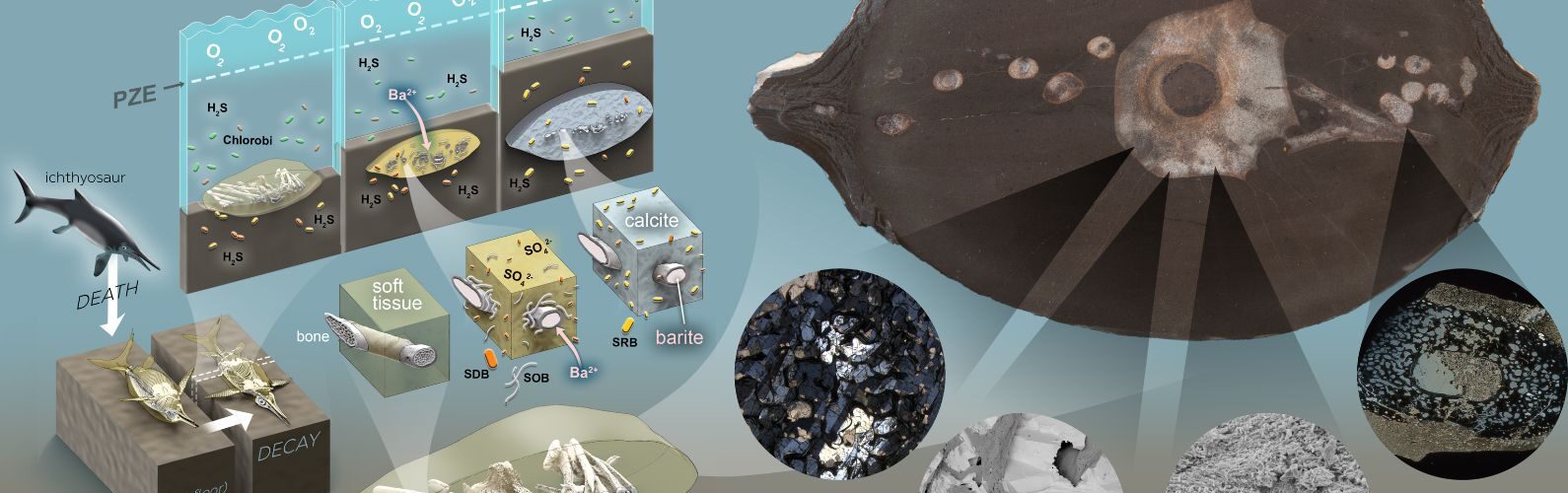
The research, published in Communications Earth & Environment, focuses on a 183-million-year-old ichthyosaur – a dolphin-like marine reptile, preserved three dimensionally inside a carbonate concretion from Germany’s Posidonia Shale.
For years, scientists believed these fossils were preserved simply because the seafloor had no oxygen, which slows decay. However, recent discoveries from around the world show signs of oxidation – a process that typically requires oxygen.
Lead author Andrew Jian, a PhD researcher at Curtin, said the team at the Western Australian Organic & Isotope Geochemistry Centre, and in close collaboration with Kiel University, set out to understand how this was possible.
“We wanted to know why fossils from oxygen-free seas still showed signs of chemical oxidation and how that helped preserve them so well,” Mr Jian said.
“Marine palaeontological sites around the world, like the Posidonia Shale, have produced fossils with an unexpected mineral makeup and geochemical signal that is very different to their surrounding sediment.”
The researchers found that after the ichthyosaur died, it sank to the anoxic seafloor, where an assemblage of anaerobic sulfur-cycling microbes colonised the decaying remains.
As they broke down fatty tissues, the microbes triggered chemical reactions that caused different minerals to form inside the bones.
One mineral, barite, formed deep within the bones and could only develop under oxidising conditions. Meanwhile, calcium carbonate formed around the bones, creating a hard rock shell.
This process strengthened the skeleton before it would be crushed under sediment loading.
Mr Jian said the bones held the answer all along.
“Ironically, these microbes acted like tiny builders even as they consumed the ichthyosaur’s fats and tissues. They filled the bones with minerals before the skeleton could collapse,”
“Barite within Posidonia Shale fossils has been noted for a long time, but few researchers have tried to explain its presence. For decades, scientists assumed no oxygen meant no oxidation. What we found shows the fossilisation story is far more complex.”
Senior author and John Curtin Distinguished Professor Kliti Grice, founding director of the Western Australian Organic and Isotope Geochemistry Centre in Curtin’s School of Earth and Planetary Sciences, said the findings alter how scientists understand fossil preservation.
“This shows that even in oxygen-free seas, tiny chemical changes driven by a sulfur cycling microbiome can determine where a fossil falls along a preservation continuum – from being completely replaced by minerals to being exceptionally well-preserved,” Professor Grice said.
“It’s not just the regional environment around the organism that matters, but what happens at the level of microbes and chemistry and microbiome inside the decaying material that can determine how a fossil forms.”
The research also helps scientists better understand how life functioned in extreme environments in the Earth’s past.
“These same processes may help guide how we look for signs of life in ancient rocks and even on other planets,” Professor Grice said.
The study was conducted with international collaborators and supported by the Australian Research Council through Professor Grice’s Laureate Fellowship and an Australian Government Research Training Program Scholarship.
The paper, ‘Microbial oxidation and carbonate cementation led to 3D preservation of ichthyosaur bones’, was recently published in Nature, Communications Earth & Environment and can be found online here.
Related stories

Poverty hits 456,000 Western Australians as housing costs deepen hardship
An estimated 456,000 Western Australians, including almost 99,000 children, are living in poverty in 2026 […]
Mysterious hot rock deep underground threatens to throw out the rule book
The discovery of an unexpectedly hot rock beneath Earth’s surface is challenging scientists’ understanding of […]

Study reveals young onset dementia’s immense impact on families
Families caring for a loved one with young onset dementia are facing years of uncertainty, […]